

What if a cleanout could restore usable space without rushing decisions about what matters? When clutter makes it hard to move through a home, even choosing where to begin can feel overwhelming. Hoarder cleanout services can turn a daunting job into a clearer plan, with belongings considered carefully before items are removed.
It’s understandable to worry about important possessions being cleared by mistake, especially when family members have different ideas about what should stay. A respectful approach starts with clear priorities and communication. Knowing what the cleanout covers and what steps come next can make the process feel more manageable.
This article explains what a hoarder cleanout involves, how to prepare, and how to set expectations around decisions and hauling. Copper State Junk Removal & Hauling is a family-run local business providing hoarder cleanouts in Chino Valley, Prescott, Prescott Valley, Paulden, Dewey, Mayer, Jerome, Clarkdale, Cottonwood, Camp Verde, the Verde Valley, and Sedona. The focus is practical property clearing that helps households reclaim access to useful areas of the home.
Key Takeaways
- Hoarder cleanout services can help make crowded areas usable again without treating the situation as a personal failing.
- Household priorities can guide the cleanout before unwanted items are hauled away.
- Separate belongings the household wants to keep from items it wants removed. A cleanout doesn’t mean everything must go.
- Prepare by identifying project areas, access needs, priorities, and who will help make decisions.
- Copper State Junk Removal & Hauling provides hoarder cleanouts in Prescott, Prescott Valley, Chino Valley, and the Verde Valley.
When Hoarder Cleanout Services Can Help Restore a Usable Home
A home can become difficult to use one small area at a time. Belongings may collect in hallways, cover tables, or make it hard to reach everyday items. When clutter starts getting in the way of ordinary routines, a planned cleanout can help the household focus on what it wants removed and which areas it hopes to make usable.
There’s no single look or story behind a crowded home. The amount of clutter, the resident’s needs, and the household’s priorities vary from one situation to another. Start with what the resident says would make daily life easier, not with judgments about appearances. That keeps the conversation practical and respects the person who lives there.
Signs a home may benefit from organized cleanout help
Consider whether belongings are blocking access to a room, a doorway, or household items used every day. Perhaps a kitchen counter is hard to reach, a chair can’t be used, or stored items have made it difficult to move through a hallway. These are practical examples of how accumulated belongings can interfere with routines, not a way to diagnose someone.
Rather than trying to tackle every room at once, identify the area the resident most wants to use again. A specific priority, such as clearing access to a frequently used room, gives family members a concrete place to begin. Listen first, then discuss what the resident considers unwanted.
What a hoarder cleanout service does, and does not mean
Hoarder cleanout services provide practical help removing unwanted items and clearing property. The household can identify what it wants hauled away and distinguish those items from belongings it plans to keep. The scope depends on the property and the household’s priorities. A cleanout doesn’t mean every possession must go.
A hoarder cleanout service handles practical hauling and property clearing; it isn’t clinical or therapeutic care. A cleanout is not a diagnosis, therapy, or a guarantee that a home will be fully restored. The overview of Hoarding disorder explains the condition as a mental health topic, which is separate from the physical work of clearing unwanted belongings.
That distinction helps set realistic expectations. A hauling service can support a household’s chosen cleanout goals, while personal or clinical concerns remain outside the scope of property clearing. Copper State Junk Removal & Hauling is a family-run local business offering hoarder cleanouts as part of its junk removal and hauling work across Central Arizona.
For a local perspective on the service, explore compassionate hoarder cleanup services in Prescott. Keep the conversation centered on the resident’s priorities and the areas they want cleared, without assuming every home or household needs the same approach.
Hoarder Cleanout: What to Expect, Priorities to Hauling
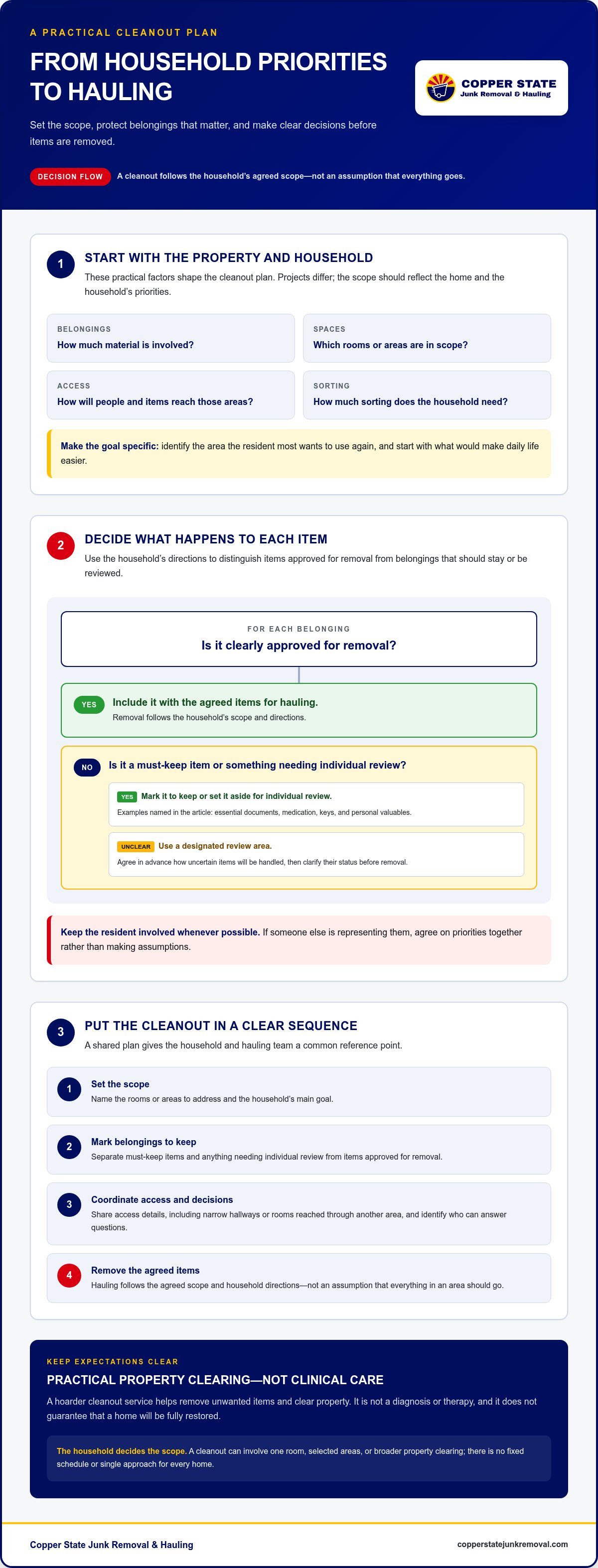
A clear plan helps everyone understand what’s being removed and what should stay. Hoarder cleanout services can involve a single room, several selected areas, or broader property clearing. The work should reflect the household’s needs, not an assumed process or fixed schedule. The amount of material, access to rooms, and sorting needs are practical factors that shape each cleanout.
Cleanout projects differ based on the volume of belongings, the spaces involved, access around the property, and how much sorting the household needs. With those details in mind, the household can set priorities before unwanted items are hauled away.
Set priorities before items are removed
Start by identifying what must remain. The resident should have a voice in those decisions whenever possible. If someone is representing them, agree on their priorities together rather than making assumptions. Set aside essential documents, medication, keys, and personal valuables for individual review so they aren’t mistaken for items to remove.
Some belongings won’t be easy to classify at a glance. Decide in advance what should happen when an item’s status is unclear. For example, you might agree that uncertain items go to a designated review area rather than being included with items marked for hauling. Clear directions reduce confusion during removal and give family members a shared reference point.
Plan the cleanout around the property and household
Before work begins, consider which rooms are in scope, how people and items can reach those areas, and who will make decisions. Mention access details that could affect moving belongings through the home, such as a narrow hallway or a room reached through another area. Coordinate who will be available to answer questions, especially if several family members are involved.
A useful plan can be organized into stages. The sequence may vary, but this outline helps clarify decisions:
- Set the scope. Identify the rooms or areas the household wants addressed and its main goal for the cleanout.
- Mark belongings to keep. Separate must-keep items and anything that needs individual review from items approved for removal.
- Coordinate access and decisions. Share how to reach the project areas and who can clarify uncertain items.
- Remove the agreed items. Hauling follows the scope and household directions, rather than an assumption that everything in the area should go.
Some households may want to focus on a specific room or route through the home. Others may be planning to clear more of the property. A focused scope can keep decisions manageable; broader clearing may require more coordination about belongings and access. Be specific about the outcome the household wants in the areas included.
Planning this way keeps the focus on practical property clearing. It doesn’t imply deep cleaning, sanitizing, repairs, or ongoing support. If you’re ready to talk through a local cleanout, discuss your cleanout needs with Copper State.
Does Hiring Hoarder Cleanout Services Mean Everything Gets Thrown Away?
No. Hiring hoarder cleanout services doesn’t mean the household must give up every possession. The service is for removing items the household has identified for removal and clearing the agreed areas. Belongings the resident wants to keep can remain. Make that distinction clear in the cleanout plan before hauling begins.
That clarity matters when someone worries that decisions will be made for them. The resident, or an authorized representative when appropriate, should have a clear role in deciding what goes. Family members can help organize and communicate, but disagreement is a reason to pause and clarify the plan, not to assume an item is unwanted.
Separate keep, remove, and undecided belongings
Use a simple three-way system to make the household’s choices visible. Designate separate areas, containers, or labels for items to keep, items to remove, and items that need more thought. Make the labels easy to understand, and keep the categories distinct so a quick decision during hauling doesn’t replace the resident’s choice.
For anything marked undecided, agree on who has the final say and how it will be reviewed. If the resident can make that decision, give them room to do so. If someone else is authorized to decide, make that responsibility clear to everyone involved. Until the item’s status is settled, don’t include it among belongings marked for removal. This is a practical way to manage property decisions, not a treatment method.
Respond to emotional concerns without judgment
Letting go of possessions can feel difficult, especially when an item carries a memory, represents a past plan, or simply feels important to the person who owns it. A calm conversation is more useful than pressure. Ask what the resident wants to keep accessible, which possessions they’re comfortable removing, and whether they’d like time to consider a particular item.
Keep the language person-first. Describe the specific area or item rather than labeling the resident or criticizing the home. For example, focus on clearing a selected space instead of judging how it looks. Small, clear decisions can help preserve a sense of control, even if the household’s broader plans take time to discuss.
It also helps to distinguish cleanout work from other kinds of support. A hauling service removes the belongings the household has approved for removal; it doesn’t make personal decisions on the resident’s behalf or provide clinical care. The scope can center on the items and areas agreed upon, without requiring an all-at-once approach.
Households facing a move may have different priorities, such as sorting possessions for a transition to a new living arrangement. In that situation, assisted living cleanout guidance for Central Arizona offers a related perspective. Whatever the circumstances, clear categories and agreed decision-making help keep the cleanout focused on the household’s choices.
How to Prepare for Hoarder Cleanout Services in Central Arizona
A little preparation can make a cleanout conversation more focused. You don’t need to sort the entire home before getting started. Gather the details that help explain what the household wants cleared, which areas matter most, and how people will coordinate decisions. A clear scope gives everyone a shared starting point without assuming every room or possession is part of the project.
Make the home and project scope easier to discuss
Walk through the planned project areas with the resident or their representative, if appropriate. Note the rooms involved, access limitations, and spaces or belongings that must remain untouched. If several relatives are involved, choose one point of contact to share the household’s priorities and help resolve questions. This keeps instructions consistent while leaving room to clarify decisions together.
Use this checklist to organize the conversation:
- Priorities: Identify the main areas the household wants cleared and what it hopes to make easier to use.
- Project areas: List the rooms, sections, or outdoor areas included, rather than describing the job only as “the whole home.”
- Access: Note the entry point, stairs, narrow passages, or other details that may affect movement around the property.
- Keep and off-limits items: Identify belongings and spaces that are not part of the removal plan.
- Decision-maker: Agree on who can answer questions if an item’s status is uncertain.
Be as specific as you can, but don’t worry about having every detail settled. For example, “clear the back bedroom while leaving the closet untouched” gives a more useful scope than “work on the back of the house.” If a room or item is uncertain, mark it for discussion instead of treating it as approved for removal.
Keep safety communication measured. If a route, room, or part of the property raises a concern, mention it when describing the project. Don’t handle or move anything you’re unsure about just to prepare for a cleanout. Share what you’ve observed so the work can be discussed with the property and household details in mind.
Get a local cleanout conversation started
For a useful first conversation, describe the property, the areas involved, the household’s main priorities, and any access details or boundaries. The amount of material, the areas included, and the sorting needs all shape the project, so clear information helps explain its scope without presuming a schedule or outcome. When describing the cleanout, note which rooms are involved, how belongings are sorted, and what access is like.
Copper State Junk Removal & Hauling is a family-run local business serving communities across Central Arizona with hoarder cleanouts and property-clearing hauling. When you’re ready, share your cleanout priorities with Copper State to start a straightforward conversation about the areas you want addressed.
Find Hoarder Cleanout Services Near Prescott and the Verde Valley
Choosing a local service makes it easier to discuss the property, the areas that need attention, and the household’s priorities with a team serving Central Arizona. Copper State Junk Removal & Hauling is a family-run business providing residential and commercial junk removal and hauling. Its specialized cleanout work includes hoarder situations, with a practical focus on removing unwanted items and clearing property.
Local hauling support for homes and properties
Hoarder cleanout services are property-clearing work. They can help households haul away belongings identified for removal, whether the project involves selected areas or a broader cleanout. The scope depends on what the household wants addressed. This is not clinical care, therapy, or a promise of restoration; it’s straightforward hauling support for a challenging property cleanout.
Copper State serves Prescott, Prescott Valley, Chino Valley, and the Verde Valley, including these communities:
- Paulden, Dewey, and Mayer
- Jerome and Clarkdale
- Cottonwood and Camp Verde
- Sedona
These service areas include communities across Central Arizona. Each property is different, so a useful first conversation can focus on the location, which rooms or areas are part of the project, and the resident’s priorities. Sharing those details keeps the discussion grounded in the actual cleanout rather than assumptions about what the home needs.
Take the next step toward a clearer space
Starting a conversation doesn’t require having every item sorted or the whole project mapped out. Begin with what you know: the property’s community, the spaces you want cleared, and any belongings or areas that should remain untouched. If family members are involved, it can help to share who will communicate the household’s decisions and answer questions about the scope.
That simple outline can turn an overwhelming situation into a more workable discussion. You can explain whether the goal is to open up a particular room, improve access through a section of the home, or address several areas. Keep the focus on what the resident wants to change and what they want to keep. Those priorities help describe the job without pressuring anyone to make every decision at once.
Copper State Junk Removal & Hauling brings a local, family-run approach to hauling and property clearing across Chino Valley, Prescott, Prescott Valley, Paulden, Dewey, Mayer, Jerome, Clarkdale, Cottonwood, Camp Verde, the Verde Valley, and Sedona. If you’re ready to take a first step, share the property’s location, the areas you want cleared, and what matters most to keep with Copper State.
Take the First Step Toward a Clearer Space
You don’t need to have every decision settled before moving forward. A first step can be as simple as identifying one area that feels important to reclaim and describing what the household wants to keep. That gives the cleanout conversation a practical place to begin, without putting pressure on anyone to solve everything at once.
Hoarder cleanout services can support that next step through focused hauling and property clearing. Copper State is a family-run local business providing residential and commercial junk removal and hauling, including specialized hoarder cleanouts. The goal is to understand the household’s priorities and discuss a workable scope for the property.
When you’re ready, share what feels manageable: the areas you want cleared, what matters most to keep, and any details that will help explain the project. Talk with Copper State about your hoarder cleanout and take one steady step toward a home with more usable space. You can begin with a conversation, then move forward at a pace that respects the people and belongings involved.
Frequently Asked Questions
How much do hoarder cleanout services cost?
There isn’t one price that fits every cleanout. Cost depends on the amount and type of material, the areas involved, access, and how much sorting the household wants to do. A small area with straightforward access differs from several packed rooms requiring individual decisions. Describe the property and your priorities when discussing a project. A national average may not reflect the scope of a particular Central Arizona home.
How long does a hoarder house cleanout take?
Timing depends on the volume of belongings, the number of areas involved, property access, and how many items need individual decisions. Clearing a focused room is different from addressing an entire home. Rather than relying on a fixed estimate found online, outline the spaces involved and the household’s priorities so the expected work can be discussed in context.
Can a hoarder cleanout service work one room at a time?
Yes, the project can be planned around a particular room or area instead of the entire property. For example, a household might want to start with a room used for daily activities, then decide later whether to address other spaces. Before work is discussed, identify the selected area and distinguish items approved for removal from belongings that should stay or be reviewed.
Is hoarding cleanup the same as regular junk removal?
Not exactly. Junk removal focuses on hauling unwanted items, while hoarder cleanout services may involve more discussion about the property’s scope and the household’s decisions about belongings. For instance, a family may need to clarify which items are approved for removal before hauling starts. Neither type of service provides a clinical assessment or mental-health treatment.
What should I do before a hoarder cleanout begins?
Make a short written outline of the rooms involved, items that must stay, and belongings that still need a decision. Keep the notes available to the person coordinating the project, and update them if the household changes its priorities. If several people are involved, agree on one set of instructions before discussing removal. This gives everyone a shared reference and helps avoid conflicting directions.
Can family members arrange a cleanout for someone else?
Family members can help start the conversation, but the resident’s preferences and role in decisions deserve respect. If someone else is coordinating, clarify who is authorized to approve removal and how the resident will be included. For example, agree on a single decision-maker for questions about belongings. A calm conversation about boundaries can help prevent misunderstandings during a difficult household change.
What happens to belongings during a hoarder cleanout?
The household identifies which belongings it wants removed and which it intends to keep. Items that matter or need more consideration shouldn’t be treated as unwanted by default. Copper State provides junk removal and hauling for cleanout projects. If an item’s status is unclear, settle that decision with the resident or authorized representative before it’s included for removal.


