

A small-looking dump can trigger a serious penalty in Arizona. The minimum fine for an illegal dumping conviction is $2,500, and according to the Arizona Legislature, litter exceeding 300 pounds or 100 cubic feet, or any amount discarded for commercial gain, is a Class 6 felony. The cost of an illegal dumping fine in AZ can involve more than a citation when the charge carries felony consequences.
The amount of waste matters, but so can where it was left and whether the offense is treated as a misdemeanor or felony. Across the states, penalties range from $50 to $50,000 or more, depending on the state, waste amount, and offense history.
This guide explains how illegal dumping penalties vary by state, property type, and offense level. You’ll find Arizona’s key thresholds alongside examples from other states, so you can understand what may affect the penalty and how a misdemeanor differs from a felony.
Key Takeaways
- Use Arizona’s legal references, SB 1196 and Arizona Revised Statutes §13-1603, to understand the rules behind dumping penalties.
- Compare state penalties carefully: the same type of conduct can carry different consequences depending on location and circumstances.
- Learn how waste quantity and commercial purpose can affect whether a dumping charge is treated as a misdemeanor or felony.
- See why the property involved matters when assessing an alleged dumping violation and its potential consequences.
How Much Are Illegal Dumping Fines in Each State?
Penalties vary by state, waste amount, and circumstances. Arizona’s classifications and fines offer a starting point for understanding the possible consequences.
Arizona Criminal Littering and Pollution
Arizona criminal littering or polluting includes leaving waste unlawfully on public or another person’s property. It also covers discharging harmful substances into state waters or onto shorelines, and dumping earth, soil, stones, ores, or minerals without lawful authority. Arizona’s penalties for hazardous-waste dumping depend on the offense circumstances; a Class 6 felony applies to any quantity discarded for commercial gain or litter exceeding 300 pounds or 100 cubic feet, according to the Arizona Legislature. The listed facts do not establish a separate penalty solely for hazardous material.
Repeat-Offense Penalties
Repeat-offense penalties are additional consequences based on a prior violation. The Arizona classifications described here distinguish offenses by waste quantity and commercial purpose, rather than giving a separate repeat-offense fine. The potential class still matters: a Class 6 felony can carry fines up to $150,000, while a Class 1 misdemeanor can carry fines up to $2,500. Don’t assume a prior offense automatically changes the charge; the conduct and applicable legal rules matter.
Arizona Illegal Dumping Fines and Statute
Arizona’s dumping statute identifies conduct and classifications used to assess criminal littering penalties. The Arizona Legislature identifies SB 1196 and Arizona Revised Statutes §13-1603 as legal references for Arizona illegal dumping fines. Arizona imposes a minimum $2,500 fine for an illegal dumping conviction. Facility charges can depend on the material and amount.
Local Fines and Dumping Reports
Local fines are city or county penalties that may apply alongside state law. Cities and counties may have local rules, so contact the relevant local authority to ask about applicable fines. To report dumping, provide the responsible city or county office with the location and a description of the waste. Arizona requires at least 50% of fines assessed for specified criminal-littering violations to support county cleanup, according to the Arizona Legislature.
Felony dumping thresholds and penalties
In Arizona, the felony threshold depends on the amount of waste and whether dumping serves a commercial purpose. Waste type and quantity can affect the charge, which may be a misdemeanor or felony.
Jail and Felony Penalties
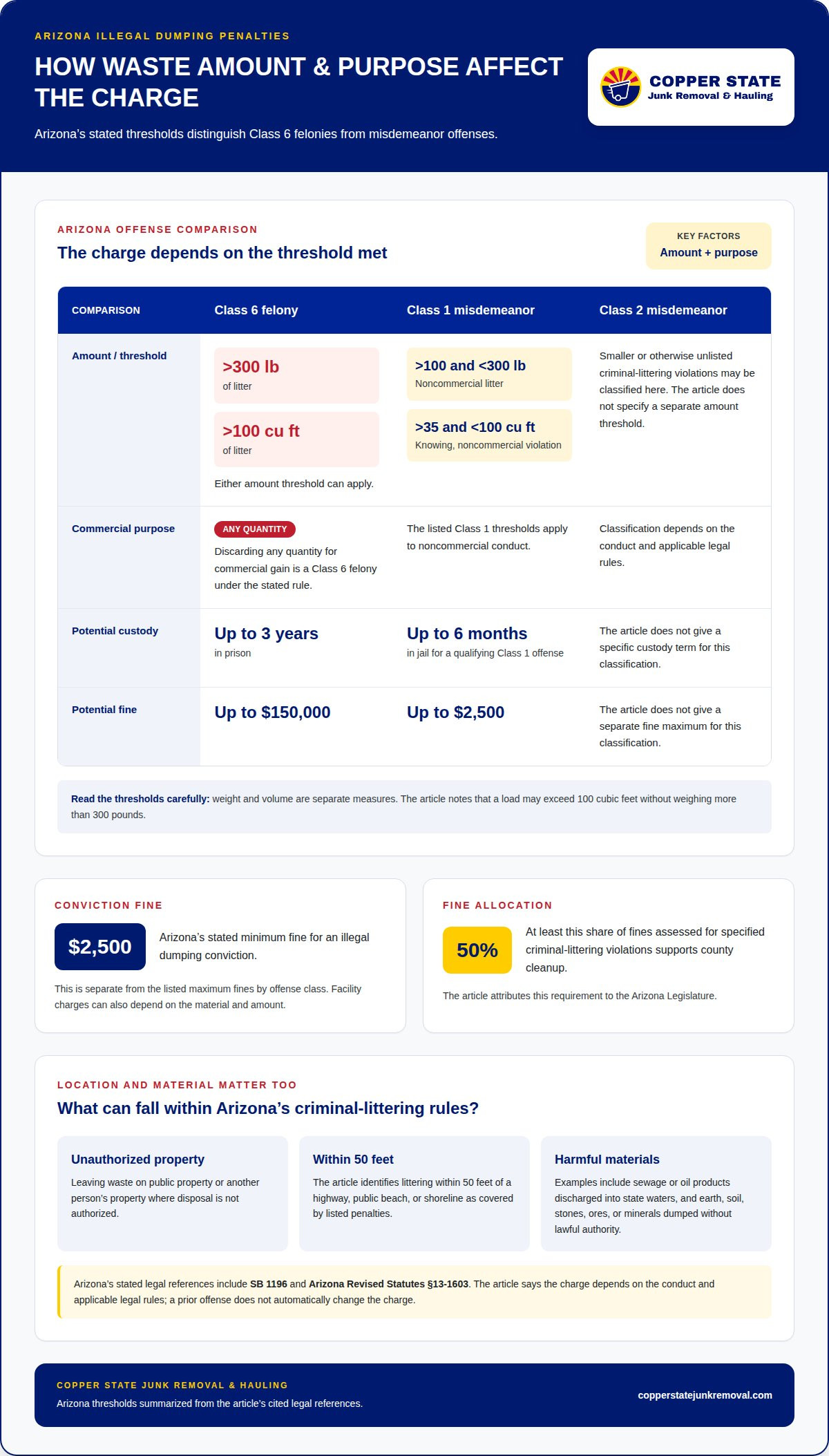
A felony is a serious criminal charge that can carry imprisonment and substantial fines. In Arizona, the Arizona Legislature classifies litter exceeding 300 pounds or 100 cubic feet, or any quantity discarded for commercial gain, as a Class 6 felony. A conviction can lead to up to three years in prison. These thresholds make the amount and purpose of disposal important parts of the charge.
Waste volume matters as well as weight. For example, a load could exceed 100 cubic feet without weighing more than 300 pounds. Commercial purpose also matters: the felony rule covers any quantity discarded for commercial gain. The charge therefore turns on the applicable threshold and whether the disposal was commercial, not weight alone.
Misdemeanor and Felony Charges
Arizona illegal dumping charges may be misdemeanors or felonies, depending on the conduct and the amount involved. Noncommercial litter exceeding 100 pounds but less than 300 pounds is classified as a Class 1 misdemeanor. Knowing noncommercial violations involving more than 35 cubic feet but less than 100 cubic feet can also be Class 1 misdemeanors.
Smaller or otherwise unlisted criminal littering violations may be Class 2 misdemeanors. That means the same general act of leaving waste can fall into different offense classes as its quantity or purpose changes. The misdemeanor range includes up to six months of jail for a qualifying Class 1 offense, while a qualifying Class 6 felony can carry up to three years in prison.
Across states, felony thresholds differ; some states treat large quantities, typically over 500 pounds, or hazardous waste as felonies. Arizona’s stated criteria focus on quantity and commercial gain. Knowing which factor applies helps explain why felony charges can arise even when the waste amount is relatively small.
Illegal dumping on public or private property
Illegal dumping on public or private property means leaving litter or harmful material where disposal isn’t authorized. In Arizona, the law covers public property and another person’s property when the site isn’t a lawful dump and the material isn’t immediately removed. A roadside shoulder, vacant lot, or unauthorized area beside a business can raise different concerns from an approved disposal site.
Property type matters, but it doesn’t make unauthorized disposal lawful. Arizona’s listed penalties also apply to littering within 50 feet of a highway, public beach, or shoreline. For example, leaving refuse near a highway may fall within that rule even if it isn’t on the road itself. The relevant questions include where the material was left, whether disposal was authorized, and whether it was removed immediately.
Some conduct goes beyond ordinary household trash. Arizona’s criminal littering or polluting law includes placing destructive or injurious material on public property or someone else’s property without lawful authority. It also covers discharging sewage, oil products, or other harmful substances into state waters or onto state shorelines. Dumping earth, soil, stones, ores, or minerals on land without lawful authority is covered as well.
These examples show why both location and material matter. A pile of soil left on someone else’s land, for instance, differs from household rubbish taken to a lawful dump. The amount and commercial purpose can also affect whether a charge is a misdemeanor or felony, as outlined in Arizona’s offense thresholds. Public ownership doesn’t grant permission to leave waste, and private ownership doesn’t make someone else’s land an authorized disposal site.
To assess a property-related allegation, identify the location, the type of material, and whether disposal was authorized. Note whether the site is within 50 feet of a highway, public beach, or shoreline. Those details help distinguish ordinary litter from conduct involving harmful substances or unauthorized dumping on another person’s land.
Misdemeanor dumping thresholds and penalties
A misdemeanor is a criminal offense that falls below a felony classification. In Arizona, the charge depends partly on waste quantity and whether the act was commercial. Noncommercial litter exceeding 100 pounds but less than 300 pounds is a Class 1 misdemeanor. Knowing noncommercial violations involving more than 35 cubic feet but less than 100 cubic feet can also qualify.
A qualifying Arizona Class 1 misdemeanor can bring up to six months of jail time and fines up to $2,500. Criminal littering or polluting outside the listed felony and Class 1 misdemeanor provisions is a Class 2 misdemeanor. That offense can carry up to four months of jail time and fines up to $750. The classification changes the potential consequences, so pounds, cubic feet, and commercial purpose matter.
State comparisons show why location matters. Florida treats noncommercial litter not exceeding 15 pounds or 27 cubic feet as a noncriminal infraction, with a $150 civil penalty. Oklahoma classifies littering as a misdemeanor, punishable by a fine between $500 and $5,000, imprisonment for up to thirty days, or both. Virginia’s misdemeanor penalties range from $500 to $2,500 and may include imprisonment for up to 12 months.
These examples aren’t interchangeable with Arizona law. Arizona’s thresholds use both weight and volume for certain noncommercial violations. A load that is small by weight could still be assessed by volume, so the applicable measurement and purpose help determine the potential offense class.
For Arizona, distinguish a Class 1 misdemeanor from a Class 2 misdemeanor before comparing possible fines or jail terms. Then compare the charge’s specific threshold with the alleged waste amount and purpose. A state’s misdemeanor label alone doesn’t reveal its penalty range: Florida’s civil infraction and Oklahoma’s criminal misdemeanor illustrate that states define and punish lower-level dumping differently.
Copper State Junk Removal & Hauling
Copper State Junk Removal & Hauling helps clear unwanted items from homes and properties through cleanout and removal services. If a household cleanout, renovation, or overgrown yard has left a pile of ordinary debris, the right next step is arranging a lawful way to clear it rather than leaving it at an unauthorized site.
Services include Hoarder Cleanup, Assisted Living Cleanouts, Mattress Removal, Hot Tub Removal, Yard Clean Up, and Renovation Cleanup. These services can help restore order during a move, renovation, or larger property cleanout. They handle the practical work of removing unwanted items, not the legal consequences of a dumping charge.
For help clearing unwanted items from a property, contact Copper State Junk Removal & Hauling.
Choose a Clear Next Step
Understanding the cost of an illegal dumping fine in AZ can help you make an informed decision, but preventing further problems starts with what happens next. Keep any citation or legal notice separate from the task of clearing unwanted items. Respond to the notice through the appropriate process, and ensure removed material has a lawful destination instead of leaving it at an unauthorized site.
If a home or property needs clearing, practical help can make the job easier to manage. Copper State Junk Removal & Hauling handles cleanouts and removal work to help restore usable space. Share what needs removing and where the work is needed, then arrange the next step with the company.
Contact Copper State Junk Removal & Hauling to discuss clearing unwanted items. A manageable plan can help you move forward with a cleaner space and greater peace of mind.
Frequently Asked Questions
Is it a crime to litter or dump waste?
Yes. In Arizona, criminal littering or polluting can include leaving waste on public property or another person’s property without lawful authority. For example, debris left on a vacant lot without permission may qualify. Whether the conduct is charged as a misdemeanor or felony depends on factors such as the amount of waste and whether it was discarded for commercial gain.
What are Arizona's fines for illegal dumping?
Arizona fines depend on the offense class and the circumstances. A Class 2 misdemeanor can carry a fine of up to $750, while a Class 1 misdemeanor can carry up to $2,500. A qualifying Class 6 felony can carry fines up to $150,000. The potential penalty reflects the alleged conduct, including waste amount and commercial purpose.
What are the fines for illegal dumping in Prescott, Arizona?
Prescott is in Arizona, so statewide criminal-littering classifications provide the relevant baseline. The possible fine depends on the charge and facts, including the amount of waste and whether the conduct meets a felony threshold. The provision and description cited on a notice can help identify the alleged offense class. Don’t assume every dumping incident carries the same penalty.
What are the fines for illegal dumping in Chino Valley, Arizona?
Chino Valley cases are subject to Arizona’s statewide criminal-littering classifications. The potential fine depends on the offense class and circumstances, such as waste quantity and commercial purpose. If a citation names a specific provision, read it alongside the alleged conduct to understand the penalty range being applied. Statewide figures are a useful starting point, not a single fine for every case.
Can Arizona illegal dumping penalties include jail time or cleanup costs?
Yes. Arizona convictions can include jail or prison time, depending on the offense class. For specified criminal-littering violations, at least 50% of the assessed fine must be used by the county for illegal-dumping cleanup. That requirement directs part of the fine toward county cleanup; it doesn’t mean every citation automatically includes a separate cleanup charge.


