
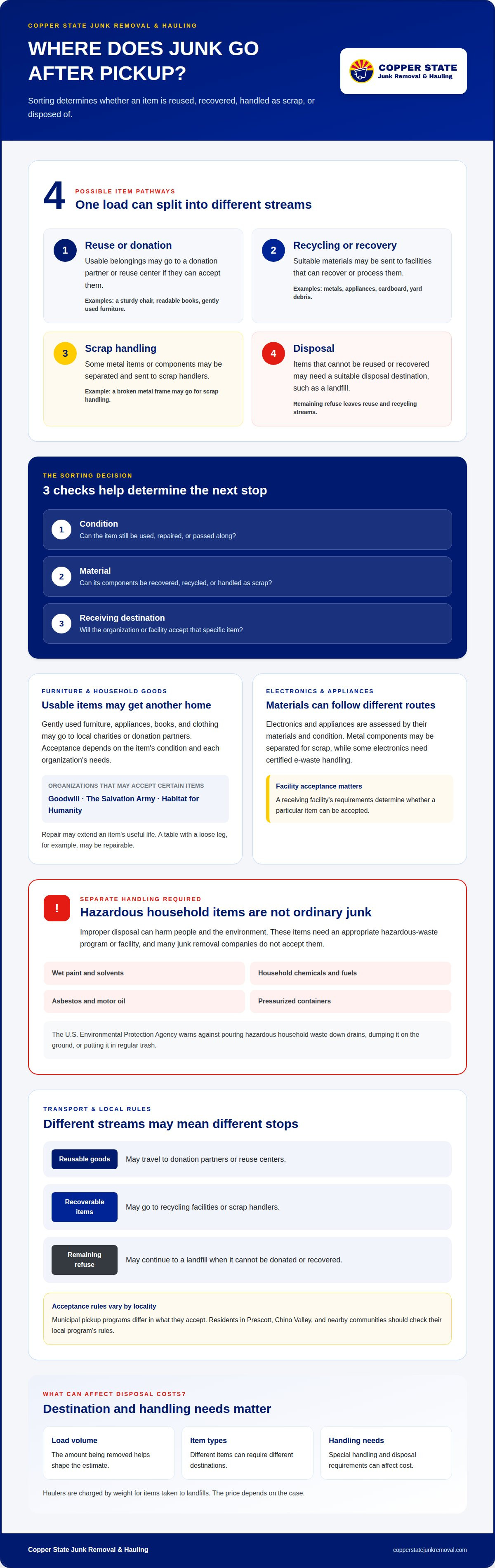
Removal starts a sorting process, not the end of an item’s story. To understand what happens to junk after removal, follow each item to its next stop: usable goods may be donated or reused, recyclable materials may go to recycling or scrap handlers, and items that cannot be reused or recycled may be disposed of. The route depends on the item’s condition, material, and what a receiving facility accepts.
It makes sense to wonder whether a sofa, mattress, or old television is simply dumped after it leaves your property. Sorting can give usable items another chance and recover materials before the remaining refuse is disposed of. Copper State Junk Removal & Hauling does its best to donate reusable items and recycle suitable materials, although acceptance depends on the receiving organization or facility.
This guide explains how furniture and electronics may be sorted, where donations and recyclable materials can go, and why some items need separate handling. You’ll also learn what may happen to items that cannot be reused or recycled, so the journey from pickup to final destination is clearer.
Key Takeaways
- An item’s condition and material help determine whether it can be reused, recycled, handled as scrap, or disposed of.
- Usable furniture and household goods may find a second home through donation partners or reuse centers.
- Electronics and metals follow different recycling paths, and some electronics need certified e-waste handling.
- Hazardous household waste needs careful handling because improper disposal can harm people and the environment.
Sorting items for recycling, scrap, donation, or disposal
Sorting separates unwanted items according to their condition and materials. That helps determine whether they may be reused, recycled, handled as scrap, or disposed of.
Sorting Into Recovery and Disposal Streams
Crews assess what may still be used, what materials can be recovered, and what must be discarded. A usable chair may be set aside for donation, while a broken metal frame may go for scrap handling. Electronics and appliances are assessed by material and condition, and some electronics need certified e-waste handling. Sorting helps match each item to a destination that can accept it.
Handling Remaining Refuse
Remaining refuse is material that cannot be donated or recovered, and may be taken to a landfill. Items a municipal pickup program won’t accept need another appropriate disposal option. In the United States, accepted items and collection rules vary by locality. Residents in Prescott, Chino Valley, and nearby communities should check their local program’s rules for accepted items.
Landfill disposal means materials leave reuse and recycling streams. Donating usable items can keep them out of landfills, while remaining refuse still needs a suitable destination. The environmental impact depends partly on what is recovered and what is ultimately disposed of.
Managing Hazardous Items Responsibly
Hazardous items require separate handling because improper disposal can harm people and the environment. The U.S. Environmental Protection Agency warns that household hazardous waste can be harmful if poured down drains, dumped on the ground, or thrown out with regular trash. Many junk removal companies don’t accept materials such as paint, solvents, household chemicals, asbestos, or motor oil.
Hazardous items such as wet paint, chemicals, fuels, asbestos, and pressurized containers cannot be removed with ordinary junk. They need a separate disposal route through an appropriate hazardous-waste program or facility. Electronics and appliances are assessed by material and condition, and some electronics require certified e-waste handling. Local requirements and accepted items vary, so disposal options differ between communities.
Transport to recycling centers, donation partners, and landfills
Once sorting identifies an item’s next destination, transport follows. Reusable belongings may go to donation partners, recyclable materials to recovery facilities, and remaining refuse to a landfill.
Moving Items to Their Destinations
Each destination handles a different stream of collected items. Donation partners receive goods they can accept for reuse, while recycling facilities process suitable materials. Remaining refuse may go to a landfill. Keeping these streams separate helps direct items to an appropriate destination instead of treating every unwanted object as trash.
A single load may need several stops because furniture, appliances, and other materials don’t all share the same route. A usable table, for example, may be set aside for donation, while recyclable metal goes to a recovery facility. Remaining refuse may then continue to a landfill. The destination and handling needs can also affect disposal costs.
Donating Usable Belongings
Donation means passing along usable belongings so another person or organization can put them to work. Gently used furniture, appliances, books, and clothing may go to local charities or other donation partners. The U.S. Environmental Protection Agency notes that donating usable items keeps them out of landfills.
Charities such as Goodwill, The Salvation Army, and Habitat for Humanity may accept certain reusable items. What they can take depends on the item’s condition and the organization’s needs. A sturdy chair or readable book may be a stronger donation candidate than a broken or heavily damaged item. Some haulers also seek local organizations that can use items other charities don’t accept.
Repair can extend an item’s useful life before it is reused or donated. A table with a loose leg, for instance, may be repairable; an item that cannot be used or recovered may instead need disposal. This distinction helps explain why condition matters during sorting.
Does the destination of junk affect junk removal prices? Yes, because handling and disposal needs can vary by destination, and haulers are charged by weight for items taken to landfills. The price depends on the case and is given after a quote request; load volume, item types, and handling needs shape the estimate.
What Happens to Furniture & Electronics After Junk Removal?
Furniture and electronics can take different paths after collection, depending on their condition, materials, and whether a receiving destination accepts them. Sorting helps separate usable belongings from items headed for recycling or disposal.
Recycling Collected Items
Recycling collected items means sending suitable materials to facilities that can recover or process them. Metal components from a broken appliance, for example, may be separated for scrap handling, while some electronics need certified e-waste handling. This separation matters because usable items, recyclable materials, and hazardous materials need different routes.
Which types of junk can be recycled, and how? Metals, appliances, cardboard, and yard debris may be directed to recycling facilities or scrap handlers, depending on their materials and condition. Some electronics need certified e-waste handling. Whether a particular item is accepted depends on the receiving facility’s requirements.
Furniture is more likely to be reused or donated when it remains usable and a receiving organization can accept it. Damaged pieces may have recyclable components, but the rest can require disposal. A collection can therefore include several destinations rather than one shared drop-off point.
Donation and Recycling Documentation
Donation and recycling documentation records what a receiving organization accepts or processes. A charity’s donation receipt relates only to items it accepts; it doesn’t document recycling or landfill disposal. This distinction matters if you want records showing the destination of donated belongings.
Do junk removal companies provide receipts or documentation for donations and recycling? Practices vary, and recycling documentation depends on the receiving facility. A receipt from a charity may cover accepted donations, but it doesn’t establish that every collected item was donated or recycled.
Some junk removal companies consign or sell selected higher-value furniture and household goods. This practice is limited within the industry, so resale isn’t the usual destination for every valuable-looking piece.
Accepted items also vary by collection program. Regular trash pickup often limits bulk items to 1-2 per month, if accepted; some municipalities offer bulk pickup with limits of one or two oversized items per quarter. A city collection may exclude furniture or electronics that a specialized recycling center accepts.
Recycling electronics and metals
Electronics and metal items often need separate handling after a hauling crew collects them. Their materials and condition help determine whether they can go to a recycling center, a scrap handler, or another destination. For homeowners, this means a mixed load may be divided again after pickup. A device that needs certified e-waste handling shouldn’t be treated like ordinary scrap.
At a recycling facility, accepted electronics are handled through its e-waste process. The exact route depends on the item and the facility’s requirements. Metals can go to scrap handlers for material recovery. Keeping these streams separate helps ensure that electronics needing different handling are not treated as ordinary metal scrap, and makes each item’s route clearer.
Before collection, homeowners can group electronics and metal items separately. A computer, television, or small appliance is an electronic item; a metal frame or other scrap piece may follow a different route. Grouping items helps with sorting, but the receiving facility’s acceptance rules and the item’s condition still determine its destination.
Some electronic items may contain components that require special handling, so certified e-waste processing is important for those devices. A recycling facility determines what it can accept and how it processes each item. If an item cannot enter that stream, it may need another suitable disposal route. Don’t assume every device or metal object belongs in the same collection container.
Donation is an option only when an item remains usable and an organization can accept it. A working appliance, for example, may be considered for donation, while a broken device may need recycling or disposal. That distinction keeps reuse separate from material recovery. Copper State Junk Removal & Hauling does its best to donate or recycle suitable items, but cannot guarantee that every item will be accepted.
For bulky items, arrange mattress or hot tub removal when clearing space around electronics and metal goods.
Copper State Junk Removal & Hauling
Copper State Junk Removal & Hauling helps clear unwanted items from homes and properties, making it easier to reclaim usable space. Its cleanout services can help during major transitions, including hoarding situations and moves into assisted living. For bulky items, mattress removal and hot-tub removal can make clearing them from your property easier.
Once you understand how removed items may be sorted, reused, recycled, or disposed of, the next step is choosing help for the physical clearing. Copper State Junk Removal & Hauling handles cleanout and removal work, while hazardous waste requires a separate disposal route.
Contact Copper State Junk Removal & Hauling to discuss clearing unwanted items from your space.
Make Room for Your Next Step
Knowing what happens to junk after removal can help you feel more confident about clearing a home or property. Start by identifying the space you want back and the items making that difficult. A single bulky item may call for a different plan than a full cleanout, while a major life transition may make a larger clear-out easier with support.
Copper State Junk Removal & Hauling helps with property-clearing needs, including hoarder cleanouts, assisted living cleanouts, and mattress removal. Share what you need cleared and what kind of change you’re preparing for to get the conversation started. The crew handles the lifting and loading, whether items are inside your home, garage, yard, or commercial space.
Contact Copper State Junk Removal & Hauling to discuss your cleanout needs and take the next step toward a more usable space.
Frequently Asked Questions
What Happens to My Stuff After a Junk Pick Up?
After pickup, items are considered individually rather than treated as one identical load. To understand what happens to junk after removal, start with each item’s condition and material: a usable appliance may be considered for reuse, while a damaged one may have recyclable parts. Items that can’t be reused or recovered may go for disposal, depending on what receiving facilities accept.
What Is Junk Hauling And How Does It Work?
Junk hauling is the collection and transport of unwanted items from a property. A crew removes belongings from places such as a room, garage, or yard, then loads and transports them for sorting. It can help with bulky belongings or mixed loads. Hauling moves items away, but it doesn’t mean every item shares the same final destination.
Where does junk removal companies take collected items?
Collected items may go to donation partners, reuse centers, recycling facilities, scrap handlers, transfer stations, or landfills. The item and each destination’s acceptance rules shape the route. In Prescott, Chino Valley, and nearby communities, municipal pickup options can differ by location, so a collection rule in one town may not apply across the region.
What happens to junk after it is picked up?
What happens to junk after removal depends on what the load contains and which destinations can accept its items. A usable bookcase, for example, may follow a different route from broken particleboard or a nonworking device. Electronics that need specialized e-waste handling are separated from ordinary household refuse and directed to an appropriate stream.
How do junk removal companies sort items for reuse, donation, recycling, and disposal?
Sorting starts by assessing an item’s condition and material. A team can separate usable belongings from damaged items, then identify metal or electronics that may have a recovery route. A metal-framed chair, for instance, may contain recyclable material even if its fabric is worn. Hazardous materials need separate handling and cannot be mixed with ordinary household refuse.
What items can be donated or resold after junk removal?
Usable household goods, including furniture, appliances, books, and clothing in good to fair condition, may be donation candidates. Local charities or reuse centers decide what they can accept based on condition and need. Some companies consign or sell selected higher-value belongings, though resale is limited in the industry. Damaged or incomplete items may be less suitable for donation.


