

Dumping trash in an unauthorized place is illegal in Arizona. Pima County says state laws and local ordinances prohibit it, and Maricopa County defines illegal dumping as leaving waste in an unauthorized or unpermitted area. In short, it is illegal to dump trash in Arizona when it’s left somewhere that isn’t approved for disposal.
It’s also fair to ask who pays to clear a dump site. Responsibility can depend on where the waste is found and whether the person who left it can be identified. Reporting the site can help the appropriate local agency investigate, but don’t approach it or handle the waste yourself.
This guide explains where illegal dumping commonly occurs, the risks it can create, and how to report it in Arizona. It also covers what may happen with cleanup and how to arrange a proper clear-out for unwanted household items. Note the location, keep your distance, and report the site to the appropriate county or local authority.
Key Takeaways
- Cleanup responsibility can depend on who left the waste and where it was dumped. Learn what may happen when the person responsible can’t be identified.
- Desert areas, vacant lots, roadsides, and other unauthorized places can become dump sites. Recognize common warning signs without putting yourself at risk.
- Report a site with its location and a description of the waste, and stay clear of materials you can’t identify.
- Use authorized disposal options for household trash and bulky items. Find out when a cleanout service can help clear unwanted belongings from a property.
Definition and common locations of illegal dumping
Illegal dumping means leaving waste in an unauthorized or unpermitted place instead of an approved disposal site. Pima County says state laws and local ordinances prohibit it, and violations can lead to prosecution. The rule applies to household garbage and items such as furniture, mattresses, tires, and construction debris.
Maricopa County says illegal dump sites commonly appear in uninhabited desert areas, open lots, roadways, alleys, and construction sites. Dumped materials can include appliances, yard waste, used oil, chemicals, and medical waste. A vacant lot or desert shoulder is not a legal alternative to a landfill or other approved disposal location.
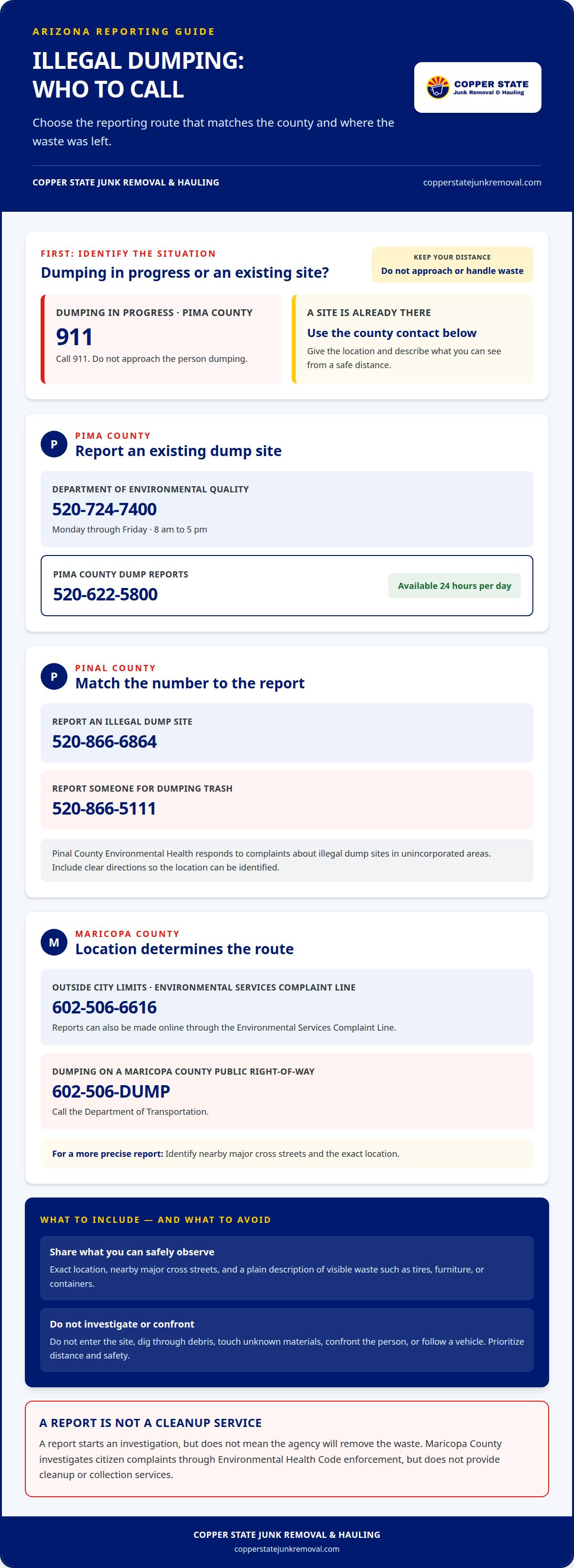
Outside city limits in Maricopa County, residents can report illegal dumping by phone to the Environmental Services Complaint Line at 602-506-6616, according to Maricopa County Environmental Services Department. Pima County says residents can report illegal dumps at 520-622-5800, available 24 hours per day. Give the location and describe what you can see without approaching the materials.
A public right-of-way is land set aside for public roads and related access. To report illegal dumping on a Maricopa County public right-of-way, call the Department of Transportation at 602-506-DUMP. For a site outside city limits, use the Environmental Services Complaint Line. Identify nearby major cross streets and the exact location when reporting.
Illegal dumps can contaminate soil and groundwater, affecting nearby neighborhoods and families. Don’t enter, dig through, or handle an unknown pile. To address dumped waste, report the site to the appropriate local authority, then follow its direction about removal. Maricopa County investigates complaints through Environmental Health Code enforcement, but does not provide cleanup or collection services. Waste removed from a property should go to an authorized disposal site, not another vacant lot or roadside.
Environmental and safety impacts of illegal dumps
Environmental contamination occurs when dumped material pollutes soil or groundwater. In Arizona, chemicals, used oil, and other discarded waste can leak from containers and spread beyond a dump site. Rainwater may carry residue across the ground, while leaking liquids can soak into soil. If contamination reaches groundwater, its effects may extend beyond the original dump site.
Groundwater is water stored below the surface in soil and rock. Contamination can make an affected area harder to use safely and may concern nearby households. Take particular care around piles containing containers of unknown liquids. Don’t open, move, or pour out a container to identify its contents. Report what you can see from a safe distance.
Physical hazards are dangers that can injure people or animals on or near a dump site. Broken furniture, sharp metal, exposed glass, and unstable piles can pose immediate risks. Children and pets may not recognize these hazards, especially if debris is near a path or open space. Keep people and animals away rather than sorting through the waste.
Medical waste and chemicals require extra care because their contents may be unclear. A sealed container can still leak, and loose material can be difficult to identify safely. Avoid touching, smelling, or handling suspicious items. Describe what you can see when reporting the site, but don’t dig through or move debris to investigate.
Nearby families can also be affected by a polluted or obstructed area. Illegal dump sites can contaminate soil and groundwater and harm neighborhoods. If you see leaking liquid, scattered waste, or notice a sharp odor, keep your distance and report the condition to local authorities. Clear details can help authorities determine whether the site needs prompt attention.
Reporting illegal dump sites
A report notifies local authorities about suspected illegal dumping. Give the site’s exact location, nearby major cross streets, and a plain description of the waste. Mention visible items such as tires, furniture, or containers, but don’t enter the site or dig through debris to identify anything.
For dumping in progress in Pima County, call 911 and don’t approach the person dumping. For a site that’s already there, Pima County residents can contact the Department of Environmental Quality at 520-724-7400, Monday through Friday, from 8 am to 5 pm. Pima County also lists 520-622-5800 for reports, available 24 hours per day.
In Pinal County, use the appropriate number for the report: call 520-866-6864 to report an illegal dump site, or call 520-866-5111 to report someone for dumping trash. Pinal County Environmental Health responds to complaints about illegal dump sites in unincorporated areas. Include clear directions so the reported location can be identified.
For illegal dumping outside city limits in Maricopa County, residents can report online through the Environmental Services Complaint Line or call 602-506-6616. For dumping on a Maricopa County public right-of-way, call the Department of Transportation at 602-506-DUMP. Choose the channel that matches the site’s location and setting.
A report starts an investigation, but it doesn’t mean the agency will remove the waste. Maricopa County investigates citizen complaints through Environmental Health Code enforcement, but doesn’t provide cleanup or collection services. Pinal County Environmental Health also responds to complaints in unincorporated areas, but doesn’t collect or clean up trash. Stick to what you observed and leave unknown or hazardous materials untouched. If you witness dumping, prioritize distance and safety over gathering details. Don’t confront the person or follow a vehicle. Record only what you can safely observe, then report it to the appropriate authority.
Where can residents legally dispose of household trash and bulky waste in Arizona?
An authorized disposal site is a landfill or transfer station approved to receive waste. Pima County says residents should take waste only to an authorized landfill or transfer station. That is the key distinction between proper disposal and leaving unwanted items on a roadside, vacant lot, or desert property.
Bulky waste means large household items that are difficult to fit in ordinary trash containers, such as furniture and appliances. Pima County says appliances and furniture can be donated to charities or neighbors for reuse. If an item can’t be reused, use an authorized disposal option rather than leaving it beside a road or on private property.
Household hazardous waste includes materials that need special handling, such as chemicals, used oil, and lead-acid batteries. Maricopa County has household hazardous waste collection and recycling locations throughout the valley. Lead-acid batteries, used tires, waste oil, and other hazardous materials should go to approved disposal or recycling facilities. Keep these materials separate from ordinary household items while arranging disposal.
Some communities offer free or low-cost disposal for certain materials. Pima County says free or low-cost disposal is available for many items, including household hazardous waste. Accepted items and options vary by disposal location, so sort materials by type and use a service designated for that waste.
A permitted hauler is a waste-removal contractor authorized to haul trash. Pima County advises residents to use a reputable contractor or a hauler with a permit. It also advises getting a landfill receipt before making full payment. The receipt helps show where the load went, rather than leaving its destination unclear.
For a large household clearout, arrange a responsible household-item removal plan before items accumulate outdoors. Keep reusable furniture separate from waste, and send hazardous materials through approved channels. These steps help move unwanted belongings toward reuse or proper disposal, not an unauthorized dump site.
Copper State Junk Removal & Hauling
Copper State Junk Removal & Hauling clears unwanted items from homes and properties, helping turn cluttered spaces into usable ones. For a cleanout that leaves bulky belongings behind, services such as Mattress Removal, Hot Tub Removal, Yard Clean Up, and Renovation Cleanup can address those items. Hoarder Cleanup and Assisted Living Cleanouts support larger property transitions.
Report illegal dump sites to the appropriate local authority, rather than treating them as ordinary household cleanouts. For unwanted items on your own property, organize what needs removing and contact Copper State Junk Removal & Hauling to discuss the project.
Choose a responsible next step for your property
A reported dump site and unwanted belongings on your own property call for different next steps. If you’re wondering whether it’s illegal to dump trash in Arizona, the key issue is leaving waste in an unauthorized place. For a pile on your property, focus on clearing usable space without shifting the problem elsewhere.
Start by separating ordinary household belongings from anything that may need special handling. Leave suspicious materials untouched and arrange disposal through an approved channel. For a property transition, Hoarder Cleanup or Assisted Living Cleanouts can help clear accumulated belongings; Mattress Removal can handle a bulky item taking up space. The right service depends on what needs to go and the condition of the property.
Cleanup can feel more manageable once the next step is clear. For help with a household clearout, contact Copper State Junk Removal & Hauling to discuss your project. A more orderly space can begin with one practical decision.
Frequently Asked Questions
Who pays for the cleanup?
Cleanup arrangements depend on the site and who is responsible. In Pinal County’s unincorporated areas, Environmental Health works with property owners to arrange cleanup but doesn’t provide collection or cleanup services. Maricopa County investigates complaints through code enforcement but also doesn’t collect or remove dumped waste. Report the site to local authorities so they can investigate and explain the process for that location.
Is illegal dumping prohibited under Arizona state law?
Yes, dumping trash in an unauthorized place is illegal in Arizona. Pima County says state laws and local ordinances prohibit illegal dumping, and violations can lead to prosecution. Local rules also matter because disposal requirements and reporting channels can differ by county or city. Use an approved disposal location rather than assuming a vacant lot or private parcel is acceptable.
What penalties and fines apply for illegal dumping in Arizona?
Pima County says illegal dumping can lead to prosecution. Consequences depend on how the matter is handled under applicable laws and local ordinances. Don’t assume that leaving a small pile or household item carries no legal risk. If you report a site, share its location and what you observed, and leave enforcement decisions to the authorities.
What counts as illegal dumping in Arizona, including dumping on private property?
Illegal dumping means disposing of waste somewhere that isn’t authorized or permitted. A private lot isn’t automatically an approved disposal site, so leaving furniture, construction debris, or household trash there can still qualify. Pima County prohibits disposing of solid waste anywhere in the county except at an approved site. Get permission to use a disposal location and make sure it’s approved.
Are there different penalties based on the amount or type of trash dumped?
The amount or type of material doesn’t make an unauthorized location a legal dumping site. Waste type does affect how it should be handled: a load containing used oil or tires needs an appropriate disposal or recycling option. Don’t sort or move an unknown pile yourself. Report what you can identify safely, and let the relevant local authority investigate.
What are Arizona’s rules for dumping hazardous waste, tires, or appliances?
Take hazardous materials, used tires, and waste oil to approved disposal or recycling facilities, not an unauthorized site. Maricopa County has household hazardous waste collection and recycling locations throughout the valley. Pima County says appliances can be donated for reuse or taken through authorized disposal options. Keep hazardous items separate from ordinary junk, and don’t put them out for general removal.


