

What if the biggest source of stress in a property clearout isn’t the pile of belongings, but uncertainty about what should leave? For realtors, junk removal works best when the owner and hauling crew agree on the scope before anything moves. That’s the starting point for junk removal for realtors: clear instructions, fewer crossed wires, and a smoother path to the next step.
Unwanted items can distract from a home’s presentation or hold up staging, renovation, or move-out preparation. When agents are coordinating owners, property access, and a hauling crew, vague directions can add unnecessary work. A simple plan helps everyone know what stays, what goes, and when the property is ready for what comes next.
This guide explains how to define the removal scope, organize a practical clearout sequence, and compare removal options for a Prescott-area listing. It also shows how Copper State Junk Removal & Hauling, a local family-run business, helps with property clearouts across Prescott and nearby communities. With the right plan, you can clear the space without adding avoidable stress.
Key Takeaways
- Set a clear removal scope before the clearout so owners, agents, and the hauling team understand what stays and what goes.
- Follow a practical sequence: confirm authority, label items, share access details, arrange removal, and review the cleared areas.
- Compare owner-led, agent-coordinated, and professional hauling options by the time, physical work, and control each requires.
- Use a checklist to document authorization, access, site constraints, and the point of contact. Separate household junk from renovation debris.
- Junk removal for realtors can support Prescott-area property clearouts, moving transitions, and renovation preparation with a local hauling partner.
When Realtors Need Junk Removal for a Prescott-Area Property
A listing may need clearing before photos, a move-out may leave furniture behind, or renovation work may wrap up with debris still in the work area. Meanwhile, you’re coordinating clients, property access, and the people preparing the home. A focused clearout can remove one obstacle, but only if everyone understands what’s being taken and what still needs attention.
Realtor-focused junk removal is the hauling of unwanted items from a property to help prepare it for its next real estate step. It can support presentation and make room for follow-on work, but it doesn’t replace staging, repairs, or cleaning. Those tasks serve different purposes. For a general overview of cleaning, see Cleaning (Wikipedia).
Plan removal as one part of the property’s preparation: identify what should leave, then schedule the work around the home’s next use. This helps prevent a clearout from being mistaken for a complete listing-preparation service and gives agents a practical way to set expectations with owners.
Which real estate transitions can benefit from hauling?
Before listing, unwanted belongings can draw attention away from a room’s layout and features. A targeted clearout can open up space for photography, staging, or other preparation. After a move-out, leftover furniture, boxes, or household clutter may need to be removed before cleaning or repairs can proceed. Following a renovation, debris may remain in the work area; Central Arizona renovation debris removal is a related consideration when planning that stage.
Each situation calls for a different scope. A pre-listing job may focus on selected rooms, while move-out leftovers could involve items throughout the property. Renovation cleanup focuses on debris from completed work, rather than belongings the owner intends to keep.
What should the agent clarify before arranging removal?
Start with authorization. Confirm that the owner, seller, property manager, or another authorized representative has approved the items for removal. Then separate the “take” list from belongings that must remain. Labels, a written list, or photos can help prevent mix-ups, especially when the agent won’t be on site during the clearout.
- Access: Explain how the crew will enter and which areas are included.
- Parking: Share practical parking details and any access limitations.
- Property condition: Point out conditions that could affect movement through the space.
- Timing: Coordinate the clearout with transaction milestones and the next preparation task.
Make the scope specific enough to guide the work without guesswork. For example, “remove the marked items in the garage; leave the labeled boxes” is clearer than “clear out the garage.” With decisions made up front, junk removal for realtors can fit more smoothly into listing, move-out, or renovation preparation across Prescott-area properties.
How to Coordinate Junk Removal for Realtors Step by Step
A clear plan gives the owner, agent, and hauling team the same instructions before work begins. For junk removal for realtors, coordination means more than choosing a date. Confirm permission, identify exactly what leaves, plan property access, and decide how the cleared areas will be reviewed. Keep the job focused on removable belongings or debris. Repairs, staging, and final cleaning remain separate preparation tasks.
Set the removal scope before scheduling
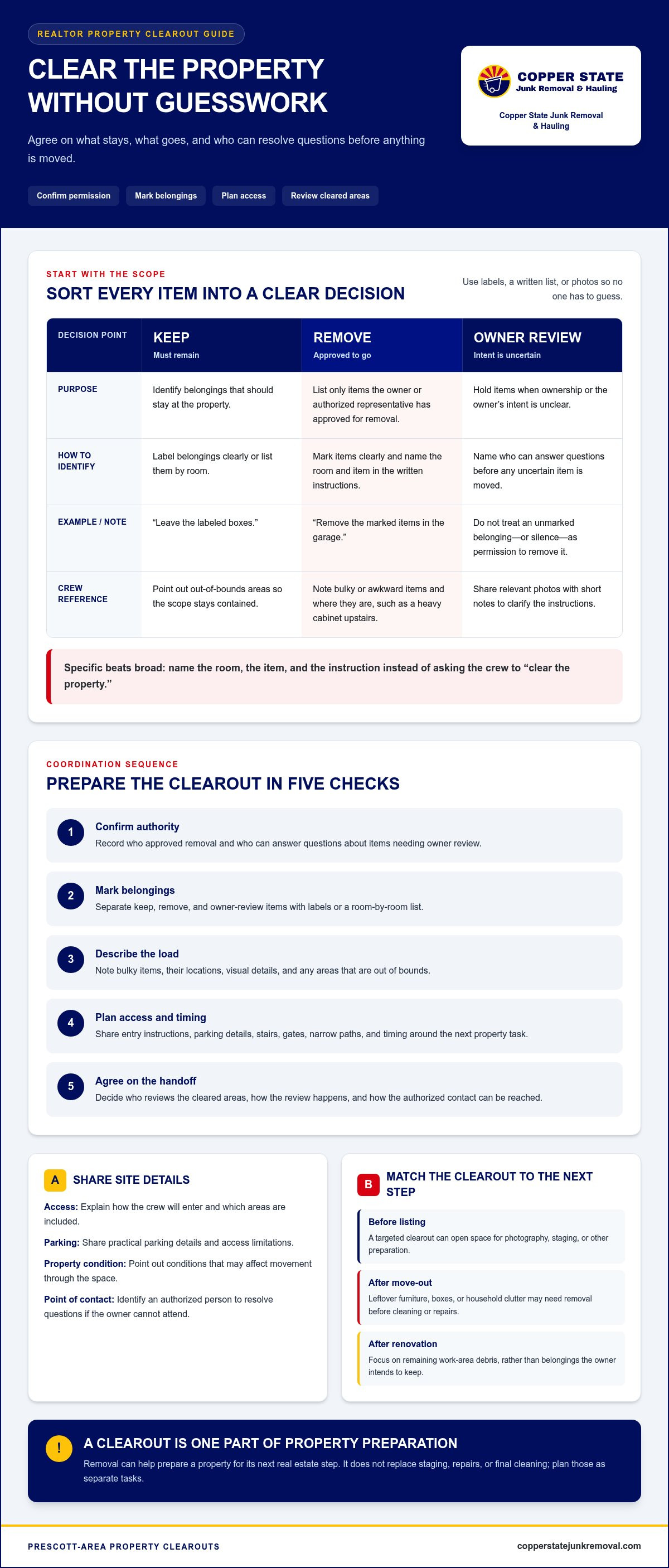
Walk through the property with the owner or authorized representative when possible. Divide items into three groups: keep, remove, and owner review. The last category is useful when ownership or intent is uncertain. Don’t leave a crew to guess whether an unmarked item is unwanted.
- Confirm authority: Record who approved the removal and who can answer questions about items in the owner-review group.
- Mark belongings: Use labels or a room-by-room list. Make the distinction clear between items to take and items that must stay.
- Describe the load: Note bulky or awkward pieces and where they are, such as a heavy cabinet in an upstairs bedroom or old materials in a back room.
- Share visual details: Send relevant photos with short notes. Include out-of-bounds areas so the scope doesn’t accidentally expand.
Written notes and photos give everyone a shared reference, especially if the agent or owner won’t be present. Keep the description practical: name the room, item, and instruction instead of relying on a broad request like “clear the property.”
Plan access and the property handoff
Once the scope is set, coordinate how the team will enter and who will provide access. Share parking instructions and relevant details such as stairs, gates, narrow paths, or other site constraints. These specifics help the crew understand the approach before arriving and reduce last-minute calls for directions.
Then agree on the handoff. Decide who will review the cleared areas, how the review will happen, and who will make decisions if an item remains uncertain. If the owner can’t attend, identify an authorized point of contact and a clear way to reach them. Don’t treat silence as permission to remove an unmarked belonging.
A confirmed removal list keeps transaction-day confusion down by making clear what leaves, what stays, and who can resolve questions. After removal, review the agreed areas against the scope. Flag anything that remains for a follow-up decision rather than folding it into repair or cleaning work. A simple closeout note helps the owner and agent understand what was completed and what preparation comes next.
For Prescott-area properties, a local hauling partner can carry out a defined clearout while the agent keeps the transaction moving. Copper State Junk Removal & Hauling is a family-run local business serving Prescott and nearby Central Arizona communities. Explore Copper State’s hauling services as you plan the property handoff.
Compare Realtor Junk Removal Options by Effort and Control
The right approach depends on the amount to remove, the owner’s capacity, and how much coordination the agent can take on. A small, clearly defined group of items may be manageable without a crew. A multi-room clearout or leftover renovation debris can call for more hands-on hauling support. Compare the trade-offs before settling on a plan.
| Option | Agent involvement | Scheduling control | Physical work | Best fit |
|---|---|---|---|---|
| Owner-led removal | Low to moderate if the owner handles the plan | Rests mainly with the owner | Owner sorts, loads, and transports items | Small, manageable loads |
| Agent-coordinated removal | High, with the agent organizing decisions and logistics | Shared with the owner and anyone doing the removal | Depends on who takes on the lifting and transport | A defined scope when the owner needs help organizing |
| Professional hauling | Focused on scope, access, and handoff details | Arranged around the property’s preparation plan | A hauling crew handles removal and transportation | Larger clearouts, move-out leftovers, or renovation debris |
When is owner-led removal a workable option?
Owner-led removal can suit a few items if the owner has time, suitable transport, and a clear destination for them. It also gives the owner direct control over sorting and deciding what to keep. The agent should coordinate within the owner’s instructions and shouldn’t take responsibility for belongings or approve their removal without authorization. Bulky items, multiple rooms, or limited time can make this approach harder to manage.
When can professional hauling simplify the job?
A hauling crew can take on the physical removal and transportation, which can be useful when a property has many items, move-out leftovers, or debris after renovation work. The agent still has a coordination role, but a defined list, access plan, and point of contact can keep back-and-forth manageable. For a local-service overview, see junk hauling expectations in Chino Valley.
Hiring help adds a handoff to coordinate, but it doesn’t have to mean more guesswork. Agree on what’s included, identify what must stay, and share access details before the removal date. That gives the owner, agent, and hauling team one practical reference instead of a chain of separate interpretations.
Choose based on the work, not on a promise of a particular sale result. No removal option can guarantee a faster sale or a higher offer. For a substantial property clearout in Prescott or nearby communities, Copper State’s local hauling service can be part of the preparation plan.
Use This Realtor Checklist to Prepare a Property Clearout
A practical checklist turns a property clearout into clear instructions instead of a string of calls and assumptions. For junk removal for realtors, document the owner’s approval, the items included, site conditions, and the next transaction milestone. Keep household belongings separate from renovation debris so the scope is easy to understand and the right preparation steps can follow.
Make the property instructions easy to follow
Use written notes and visible labels rather than relying on verbal directions alone. Mark items that must stay, including fixtures and belongings the owner has set aside. If a room or area is off limits, state that plainly and include it in the notes shared with everyone involved.
- Authorization: Record who approved the clearout and who can make decisions if an item’s status is unclear.
- Item labels: Mark what should go, what must remain, and what needs the owner’s review.
- Separate categories: List household junk apart from renovation debris. For example, note leftover furniture in one group and materials from completed work in another.
- Access instructions: Explain entry arrangements, parking, stairs, gates, and any other site constraints.
- Restricted areas and hazards: Identify rooms that aren’t part of the job and share relevant property conditions that could affect access.
- Point of contact: Name one person who can answer questions and has authority to resolve uncertainties.
Photos can make directions easier to follow. Pair each image with a brief note about the room and the instruction, such as “remove the marked items beside the garage wall” or “leave everything in the locked storage room.” For items with special disposal requirements, check current guidance from the relevant local government or another authoritative source before giving item-specific instructions. Rules can vary by location and item, so don’t rely on assumptions.
Coordinate around listing and transaction milestones
Start with the next date that depends on the property’s condition, such as photography, showings, renovation work, or a possession handoff. Work backward to allow time for the owner or authorized representative to review the list, resolve uncertain items, and provide access details. Don’t treat removal as a substitute for the cleaning, repairs, or staging that may follow.
Before the job, make sure the contact person knows how questions will be handled. Afterward, do a brief walkthrough of the agreed areas. Compare what remains with the removal list, and flag anything outside the agreed scope for a separate decision. That final check helps prevent a leftover item from being mistaken for an oversight or an instruction to remove more.
Copper State Junk Removal & Hauling serves Prescott, Prescott Valley, and communities across the Verde Valley. Arrange a local property clearout with a written scope and straightforward site instructions.
Arrange Local Junk Removal for Realtors with Copper State
A clear property scope gives a hauling team useful direction and helps the agent keep the next preparation step in view. Copper State Junk Removal & Hauling is a family-run local business serving residential and commercial customers in Prescott and nearby Central Arizona communities. Its junk removal, hauling, property clearouts, moving-transition clearouts, and renovation cleanup support real estate professionals preparing homes and other properties for a change in use.
Junk removal for realtors may be part of pre-listing preparation, a move-out transition, or cleanup after renovation work. The goal is to remove the agreed belongings or debris, not to replace staging, repairs, or final cleaning. A defined scope connects the hauling work to the property’s actual needs.
Where Copper State serves real estate professionals
Copper State serves Chino Valley, Prescott, Prescott Valley, Paulden, Dewey, Mayer, Jerome, Clarkdale, Cottonwood, Camp Verde, the Verde Valley, and Sedona. That local coverage is relevant for agents handling properties across nearby markets. Whether the property is a residence or a commercial space, clear instructions about its location and the requested work help shape a practical clearout plan.
What to share when planning a clearout
Before discussing the job, gather a few details that make the request concrete. Share the property location, the rooms or outdoor areas included, and an approximate description of the belongings or debris. Note the transaction milestone the work needs to fit around, how access will be arranged, and who can answer questions about the scope.
- Property location: Include the city and enough information to identify the site.
- Removal areas: Name the rooms, garage, yard, or work area included in the clearout.
- Approximate scope: Describe the general contents, including larger items or renovation debris.
- Access and timing: Explain entry arrangements and the preparation milestone you’re planning around.
- Keep instructions: Identify fixtures and owner-designated belongings that must remain.
- Point of contact: Provide the name of the person authorized to answer questions or clarify instructions.
Photos and a written list can turn those details into a shared reference. Separate household belongings from renovation debris, and flag anything that still needs an owner’s decision. This gives the hauling team a clearer picture of the requested work and helps the agent avoid repeated explanations as the property moves toward its next step.
Have a property in Chino Valley, Prescott, Prescott Valley, Paulden, Dewey, Mayer, Jerome, Clarkdale, Cottonwood, Camp Verde, the Verde Valley, or Sedona to clear? Talk with Copper State about a property clearout and share the location, scope, access details, and items that need to stay. A straightforward conversation can help you plan the next step with a local hauling partner.
Make the Next Property Handoff Easier
Make each clearout plan a repeatable part of your property-preparation routine. A short, shareable brief gives owners and everyone involved one place to refer to as plans change. It also leaves you more room to focus on decisions that need your real estate expertise, rather than sorting through avoidable uncertainty about the property.
For your next listing or move-out, start with the owner’s priorities and the property’s next milestone. Then shape the removal plan around those needs. A thoughtful approach to junk removal for realtors can keep the work focused and make the handoff more manageable, without promising a particular transaction outcome.
If a property in the Prescott area needs a clearout, take the next step with Copper State. Discuss your property clearout with Copper State and share what you’re preparing for. A clear starting point can help you move forward with confidence.
Frequently Asked Questions
Can a realtor arrange junk removal before a home is listed?
Yes, a realtor can coordinate a pre-listing clearout once the owner or authorized representative approves it. For example, confirm whether the owner wants an old dining set removed but the basement shelving left in place. Make sure the person approving the work can also arrange property access, then fit the clearout into the listing-preparation schedule. Hauling removes agreed unwanted items; it doesn’t take the place of staging, repairs, or cleaning.
Should a realtor remove items left behind after closing?
Not without first checking the purchase agreement, closing documents, and instructions from the parties responsible for the property. An item left in a Prescott-area home isn’t automatically available for removal, and an agent shouldn’t assume they have authority to dispose of it. Ask the responsible party to clarify ownership and provide approval. If the buyer and seller disagree about an item, resolve that question before arranging hauling.
What information should an agent provide for a junk removal estimate?
Share the property location, the rooms or outdoor areas involved, and a clear description of what should be removed. Photos can show the amount and placement of belongings, while notes about stairs, gates, or limited parking can clarify access. Identify anything that must stay, too. These details help describe the job without guesswork. For more on factors that can shape an estimate, see the junk removal pricing guide.
Can junk removal help prepare a property for listing photos?
Yes, removing owner-approved belongings can clear visual distractions and make it easier to prepare rooms for photography. For example, clearing extra furniture from a living room may help the photographer frame the space. Coordinate the removal plan with the owner and any photographer or staging professional so the rooms are ready for their next preparation step. Hauling is one part of the process, not a substitute for cleaning, repairs, or staging.
Who needs to approve junk removal at a property?
Approval should come from the owner or someone with clear authority over the property and the items. A listing or transaction role alone shouldn’t be treated as permission to dispose of belongings. Put decisions in writing, especially for items shared by several people or designated to remain. Also identify who will arrange access and who can review the cleared areas. Clear authorization helps protect everyone from acting on assumptions.
Does junk removal include cleaning a home after belongings are hauled away?
No, junk removal covers the items included in the agreed hauling scope, not a full home cleaning. Once unwanted belongings are gone, floors, counters, and other surfaces may still need separate attention. For a Prescott listing, plan cleaning as its own step, alongside any repairs or staging. Before removal begins, spell out which items and areas are included so no one expects hauling to leave the property fully cleaned or photo-ready.
What should happen if a property contains renovation debris?
Separate renovation debris from household belongings and describe the material and work areas clearly. A pile of removed trim in one room, for example, is a different scope from furniture left elsewhere in the home. Disposal requirements can vary by material and location, so check current guidance from an authoritative local source before giving item-specific disposal instructions. Coordinate the debris removal with the renovation plan so it doesn’t interfere with unfinished work.


