
A local junk removal vs. national chain comparison has no universal price winner: minimum charges and quotes depend on the provider and the job. Local companies may offer a more direct, tailored service, while national franchises often follow a consistent process across locations. The right fit comes down to what you need removed and how much space it takes up.
Start by comparing the minimum charge and what it covers. For a few items, that minimum can have a noticeable effect on the total. For a larger cleanout, consider truck capacity, labor, loading, and disposal, along with the scope of the work.
This guide explains how to compare local pricing and minimum charges with national chains, and what to consider when choosing a local hauler or franchise. You’ll see how service areas, volume-based pricing, and franchise operations can shape the experience, so you can look beyond the starting charge and choose what suits your cleanout.
Key Takeaways
- Minimum charges vary, so compare quotes against the items you have and the space they’ll take in the truck.
- Look beyond the starting price: labor, disposal, truck capacity, and the scope of the job all shape the quote.
- National franchises offer broader coverage and a more standardized process, while local providers may tailor service to the job.
- For a complex cleanout, such as a hoarding situation or assisted-living transition, consider a service built for more than a routine pickup.
How does your pricing compare to national junk franchises?
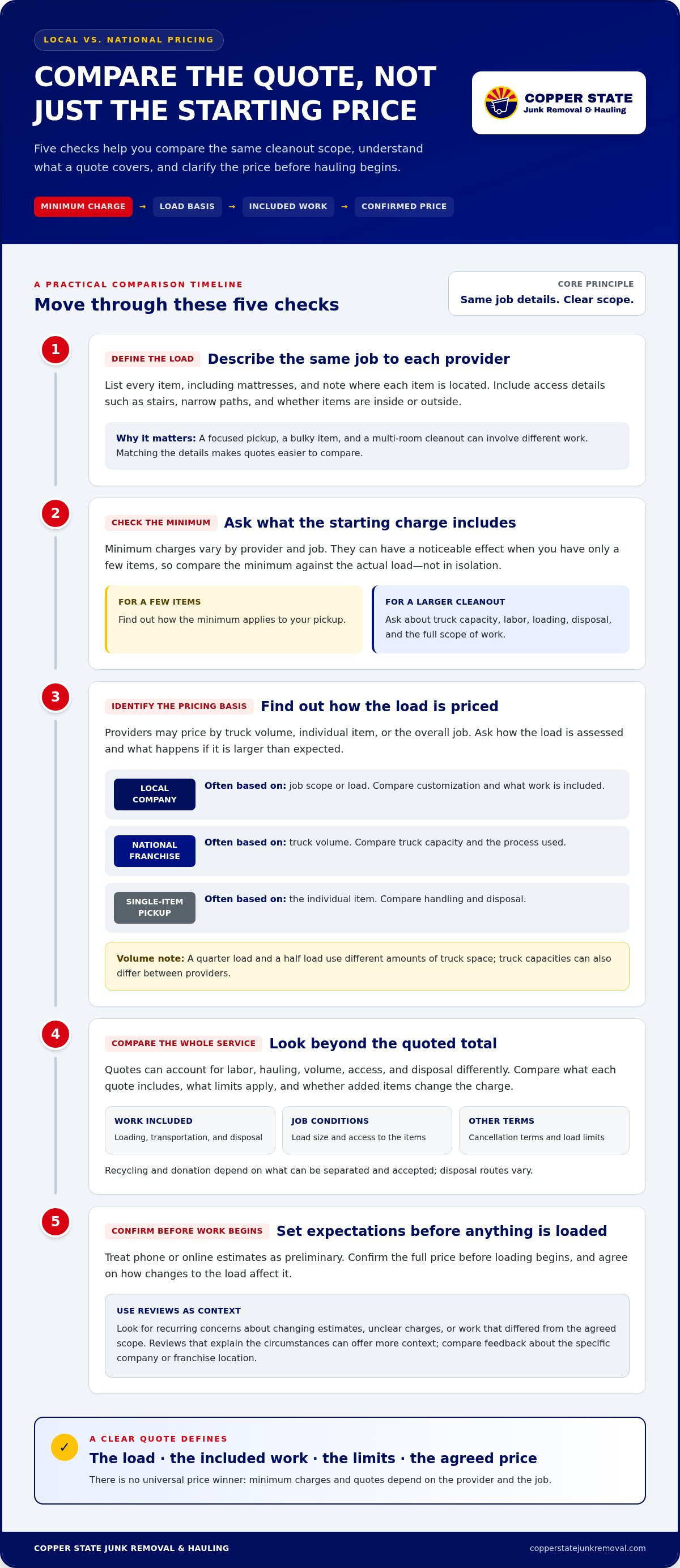
A local junk removal vs. national chain comparison starts with the minimum charge and what it includes. Quotes can vary because providers account for labor, hauling, volume, access, and disposal differently. Treat phone or online estimates as preliminary, and confirm the full price before loading begins.
For a local junk removal vs national chain decision, compare the same job details, not just the quoted total. List every item, including mattresses, and note where it sits. Ask what the quote covers, what limits apply, and whether added items change the charge. Recycling and donation depend on what can be separated and accepted; disposal routes vary.
Local and National Pricing
Local companies may tailor a quote to a specific job, while national franchises commonly use truck space as a pricing basis. A standardized process may make quotes easier to compare, but truck capacities can differ. Compare the load basis, labor, and disposal, not the company label.
Customer Reviews and Pricing Complaints
Use reviews to spot recurring concerns about changing estimates, unclear charges, or work that differed from the agreed scope. A useful review explains the circumstances, such as extra items added after the quote. Compare feedback about the specific local company or franchise location. Before work begins, agree on the price and clarify how changes to the load affect it.
Truck-Volume Pricing and Other Structures
Providers may price by truck volume, individual item, or the overall job. A quarter load and a half load take up different amounts of truck space, while a single bulky item is priced differently. Ask how volume is assessed and whether the price changes if the load is larger than expected. Cancellation terms also vary, so understand them before booking.
| Option | Pricing basis | Compare |
|---|---|---|
| Local company | Job scope or load | Customization and included work |
| National franchise | Often truck volume | Truck capacity and process |
| Single-item pickup | Individual item | Handling and disposal |
Choose the quote that clearly defines the load, included work, and limits before hauling begins.
Local versus national provider comparison
Local haulers can tailor a job to nearby needs, while national chains offer a recognizable booking process across locations. A local company can offer direct knowledge of communities such as Prescott and Chino Valley; a chain may provide a consistent framework. Consider the job scope, service area, and pickup type when deciding which is the better fit.
For a garage cleanout, compare the full scope of work, not a short headline quote. Picking up a couch or appliance is different from clearing several rooms. A dumpster rental may suit projects that unfold over several days, but it means managing the container and its limits. Junk removal includes hauling as part of a scheduled service, so compare what each option covers.
Local Haulers and Price Comparisons
Local quotes can account for the specific load, access, and items being removed. For a Prescott Valley furniture pickup, describe stairs, narrow paths, and whether items are inside or outside. A local hauler may cost less for a focused job, but the price alone doesn’t show whether loading, transportation, and disposal are included. Compare the same job details across quotes.
A company’s history and a crew’s experience are different measures. A longer company history doesn’t guarantee that the crew assigned to your job has handled similar work. For a packed garage, look for a clear scope and relevant experience with bulky items and access challenges.
Choosing and Vetting a Provider
When assessing a company, review its licensing and insurance information, and look for customer feedback about specific jobs. Notice recurring comments about communication, care inside the home, and whether the completed work matched the agreed scope. A detailed review about moving furniture from an upstairs room offers more context than a brief rating.
Before booking, list the items, access details, and anything that must stay. Confirm that the quoted work includes the removal and disposal you expect. This is useful for a move-out in Cottonwood or a mixed garage cleanout, where a clear item list helps define the job.
| Option | Best fit | Compare |
|---|---|---|
| Local hauler | Focused pickup or cleanout | Scope and included work |
| National chain | Standard booking process | Service boundary and process |
| Dumpster rental | Project spread across days | Container limits and handling |
Choose the option whose scope, experience, and service limits match the job.
National franchise coverage and standardized service
National franchises operate across many metro areas, while local haulers focus on their own service regions. Coverage matters when scheduling a pickup across city boundaries or arranging removal for a single item. A provider’s broad footprint doesn’t automatically mean it serves every nearby community.
Local companies may offer more flexible scheduling, while national franchises generally follow a standardized process. Local haulers may provide same-day pickup for calls before roughly 11 a.m., commonly with a two-hour arrival window. National franchise appointments may have a two- to four-day wait during spring cleanout season and after storms.
To compare private hauling with local waste collection, check your community’s official information about bulky-item rules, collection schedules, and accepted items. Residents in Prescott, Chino Valley, or Cottonwood can use those details to understand how municipal collection differs from private removal. The two options may cover different items and services.
Coverage doesn’t mean every item can be removed. Hazardous items such as wet paint, chemicals, fuels, asbestos, and pressurized containers cannot be taken by Copper State Junk Removal & Hauling. For ordinary items, name each one when arranging pickup, especially mattresses and appliances, so the crew can plan for the load.
Customer support can differ, too. A franchise’s shared booking process may create consistency across locations, while a local company can answer questions about its own service area. For a large cleanout, provide the address, access details, and item list when scheduling. These specifics help define the pickup plan.
Demolition and excavation are different from hauling away loose junk. A crew removing furniture from a garage is clearing items, not tearing down a structure or digging a site. Explain whether the job involves loose debris or structural work, because that distinction defines the removal service needed.
Choose based on the job’s location, item restrictions, and timing needs. For a spring pickup in Prescott Valley or Sedona, compare scheduling windows, accepted items, and service areas before booking.
National junk removal franchise model
A national franchise combines a shared brand with local operations. That structure can make booking and service expectations more consistent across locations, but crews and staffing still vary. A typical franchise pickup uses a uniformed crew of two people, though staffing differs by location. The brand is national; the work happens locally.
That distinction matters inside a home. A crew may need to carry appliances through a narrow hallway, move furniture from an upstairs room, or work around a packed garage. The company name alone doesn’t describe access, item placement, or the work involved. Give a clear item list and explain the route from each room to the truck.
Franchise systems can standardize steps such as scheduling, uniforms, and quote presentation. The local crew still shapes how the service feels on the day. For example, crew assignments can differ between two locations under the same national franchise. Treat the stated process as a framework, then focus on the scope and plan for your address.
Donation and recycling are also worth discussing. A company’s national name doesn’t tell you whether a particular chair or appliance will be donated, recycled, or discarded. Separate reusable items and identify them clearly before pickup. That helps distinguish what you want removed from belongings you intend to keep.
Use three details to decide whether the franchise structure suits your job: the service area, the crew’s plan, and how separated items will be handled. For a single appliance, a standard pickup process may be straightforward. A mixed cleanout needs clearer instructions about rooms, access, and which items should stay.
For a cleanout that needs hands-on hauling, plan your junk removal around the items and spaces involved.
Copper State Junk Removal & Hauling: Hoarder Cleanup
Copper State Junk Removal & Hauling provides Hoarder Cleanup for people managing an overwhelming accumulation of belongings. This service helps clear space and make the next steps more manageable. The company also provides Assisted Living Cleanouts for transitions involving household items.
For a focused pickup, Copper State Junk Removal & Hauling provides Mattress Removal and Hot Tub Removal for bulky items that can be difficult to move alone. Consider the scope: removing one mattress is different from a room-by-room cleanout, and a hot tub requires a different removal plan. Describe the items and spaces involved so the work is clear.
Contact Copper State Junk Removal & Hauling to discuss a cleanout or bulky-item removal.
Make the Next Step Easier
The local junk removal vs. national chain choice is only one part of clearing a space. Start by identifying what needs to go, what must stay, and which rooms or items need attention first. A simple inventory makes the scope easier to explain and helps you move forward with a clear plan.
For a more involved home cleanout, Copper State Junk Removal & Hauling provides Hoarder Cleanup and Assisted Living Cleanouts. For a focused removal, Mattress Removal can handle a bulky item. Choose the service that matches the job, then share the situation and items involved.
When you’re ready to take action, contact Copper State Junk Removal & Hauling to discuss your cleanout or removal needs. A more manageable space can start with one clear next step.
Frequently Asked Questions
Do you have lower minimum charges than the big chains?
A local provider doesn’t automatically have a lower minimum than a national chain. Each business sets its own minimum, which may reflect the trip, loading time, item type, and disposal needs. For one mattress, compare the minimum with the full pickup scope, not just an advertised starting figure. A larger cleanout may be priced by load rather than as a single-item pickup.
What advantage does a local company have over a chain?
A local company can focus on nearby communities and customer needs. For a property in Chino Valley or Prescott, details such as a narrow driveway, an upstairs room, or a move-out cleanout help define the job. A direct, specific conversation is particularly useful when the work goes beyond a simple single-item pickup.
What's In This Guide?
This guide helps you compare local haulers and national franchises beyond advertised minimums. It explains how to assess a quote, understand the franchise model, and account for service areas and item limits. It also connects different cleanout needs, from one bulky item to a larger property clearout, with practical details to organize before scheduling.
How do local junk removal and national chains compare on price and minimum fees?
Compare the complete quoted scope, not just the minimum. Check whether the quote covers the exact items, loading, transportation, disposal, and any special access or handling. For a Prescott Valley move-out, list furniture and appliances separately, and identify anything that must stay. This makes differences in proposed work easier to spot, even when providers use different pricing structures.
What extra fees can junk removal companies charge for heavy, bulky, or difficult-to-access items?
Charges may reflect extra labor, weight, dismantling, or difficult access, such as carrying a bulky item down stairs. Copper State Junk Removal & Hauling provides upfront, volume-based pricing with no hidden fees. Quotes include labor, loading, transportation, responsible disposal, and cleanup. The price depends on the job, including item type, weight, and accessibility.
What should I ask before booking a junk removal service?
Prepare a clear job description: list each item, say where it is inside the home or yard, identify narrow paths or stairs, and note what must stay. Mention whether the job involves a full room or a single appliance. In Cottonwood or Camp Verde, these details help shape a useful removal plan. Hazardous items such as wet paint, chemicals, fuels, asbestos, and pressurized containers cannot be removed.


