

What is keeping unused stuff actually costing you? The Hidden Cost of Keeping Stuff You Don't Use isn't just the money spent buying it. In a Prescott home, unused belongings can take over a closet, crowd a garage, and claim time whenever you move, clean, or search for something you need.
If deciding what to let go brings up guilt, you're not alone. An item may matter because it was a gift, once served a purpose, or might come in handy someday. That doesn't mean you have to clear everything out or judge yourself for keeping it. The goal is to make room for what supports your life now.
This article offers a practical way to weigh the trade-offs of keeping unused belongings. You’ll look at the space, effort, and attention they require, then choose a manageable first step, whether that’s one crowded shelf, a closet, or part of the garage. You can make progress without pressure, one decision at a time.
Key Takeaways
- The Hidden Cost of Keeping Stuff You Don't Use includes the space, time, and attention belongings continue to require.
- Guilt, memories, and “someday” plans can make decisions harder, but they don’t have to make the decision for you.
- Weigh how often you use an item, whether future use is realistic, and how its storage burden compares with its personal meaning.
- Start with one small area, sort its contents, and give each item a clear next step instead of tackling the whole home at once.
- When a clear-out feels too large to manage alone, local junk removal and hauling can help move the project forward.
The hidden cost of keeping unused stuff: space, time, and upkeep
Unused belongings often build up gradually. A box goes into the garage during a move, an extra chair stays after a room is rearranged, and clothes that no longer fit remain in the closet. None of these choices is automatically a problem. But over time, belongings can take up more than a corner or shelf.
The Hidden Cost of Keeping Stuff You Don't Use is the ongoing space, time, attention, and upkeep those belongings may require. Some costs are measurable, such as money spent on storage or supplies to protect possessions. Others are practical trade-offs: a crowded area may be harder to use, or sorting through stored things may take time you’d rather spend elsewhere. You don’t need to assign a dollar value to every inconvenience to see its effect.
An item's purchase price is in the past; its household footprint continues as long as it occupies space and needs attention.
How unused belongings take up more than physical space
A closet packed with rarely worn coats can leave everyday clothes harder to reach. Boxes in a garage can block access to tools, while furniture in a spare room may limit how you can use it. The issue isn’t simply owning things. It’s whether they fit the way you want to use your home.
Stored belongings can also make routine tasks take longer. You might shift bins to sweep, move boxes to reach seasonal decorations, or search a crowded shelf for one useful item. An organized collection you use and enjoy may earn its space. The trade-off changes when reaching or moving things becomes a repeated hassle.
The everyday effort that can go unnoticed
Small tasks add up: dusting objects on a shelf, rearranging items to reach something behind them, or checking boxes to find what’s inside. The effort depends on the item, its condition, how it’s stored, and how often you handle it. There’s no single measure that fits every home.
Some people also find it emotionally difficult to let belongings go. That experience alone doesn’t mean someone has a disorder. Compulsive hoarding is a distinct topic, and its broader context can help explain why difficulty discarding may be more complex for some people. For everyday decisions, notice what an item asks of you and whether that ongoing effort feels worthwhile.
Why we keep things we rarely use: guilt, memory, and someday plans
There are understandable reasons an item stays. A gift can carry a relationship with it. A box of old photographs may hold memories, while a tool or piece of equipment might seem useful for a project you hope to tackle. Keeping something doesn’t mean you’re doing anything wrong. The useful question is whether the reason still fits your life today.
One common decision-making trap is the sunk cost fallacy: giving too much weight to money or effort already spent, even though keeping an item can’t recover it. Past spending can’t be reclaimed through continued storage. That doesn’t mean you must let go of something valuable or useful. It simply gives you room to judge it by its present purpose, rather than by what it once cost.
Does the money already spent mean you should keep it?
Try a fresh-start question: if you didn’t own this item, would you choose to bring it into your home today? A rarely used appliance, for example, might still earn its space if you rely on it for a particular task. If you wouldn’t buy it now, consider whether keeping it serves a current need or mainly helps you avoid feeling that the original purchase was wasted. Either answer is yours to make.
Sentimental value and the someday pile
Memories matter. You might keep a family member’s recipe box, a child’s handmade card, or an object that reminds you of an important chapter. Those keepsakes can be meaningful even if they’re not practical. It may help to separate them from items you keep mostly because deciding feels uncertain. The psychology of hoarding offers context on why discarding possessions can be emotionally difficult, though ordinary attachment or indecision alone doesn’t define a disorder.
For “someday” belongings, make the intended use specific. Instead of “I might need this,” ask: What would I use it for, and is that likely within a timeframe that makes sense for me? A camping stove kept for a planned trip has a clear purpose. Supplies for a project with no next step may be taking up space without supporting a real plan.
The Hidden Cost of Keeping Stuff You Don't Use can feel harder to assess when guilt or memories are involved. There’s no need to force a quick decision. If you’ve sorted what matters and still have a larger pile to clear, local junk removal and hauling can help with the physical work while you focus on the decisions that feel right.
Keep it, use it, or let it go? Compare value with the space it takes
A purchase price or possible future use doesn’t settle whether an item belongs in your home today. A useful decision weighs what it does for you now, how realistic its next use is, and what it takes to store and access it. The Hidden Cost of Keeping Stuff You Don't Use becomes easier to judge when you compare those factors side by side, without treating any one answer as a rule.
Questions that reveal an item's current value
Start with a few practical questions: When did you last use it? Is there a specific upcoming reason to keep it? Do you already own something that serves the same purpose? Then consider its condition, whether you can reach it when needed, and whether it carries personal meaning. A rarely used item may still deserve a place if it’s important to you or has a clear role.
| Factor | Questions to consider | What the answer may suggest |
|---|---|---|
| Regular use | Do you use it often, or reach for it during a particular season? | Frequent or reliably seasonal use may justify keeping it accessible. |
| Realistic future use | Is there a specific plan or occasion coming up? | A defined purpose is easier to weigh than a vague “maybe someday.” |
| Storage burden | Does it block useful space or take effort to move, maintain, or reach? | A heavier burden may be a reason to reconsider where or how it’s stored. |
| Personal meaning | Does it hold a memory or matter to someone in your household? | Meaning can be a good reason to keep something, even if it isn’t practical. |
When the storage burden changes the calculation
Look at what the item’s location prevents you from doing. Is a treadmill crowding the area you want to use for exercise? Do boxes make it difficult to reach tools or park in the garage? The inconvenience doesn’t mean the item must go. You could move it, make it easier to access, or decide that the space it claims is worth the benefit it provides.
Keep the choice personal. A well-used seasonal item, a treasured heirloom, and an awkward object with no clear purpose call for different decisions. If you’re weighing the cost of help for a larger clear-out, see the separate guide, “When Junk Removal Is Worth the Money.”
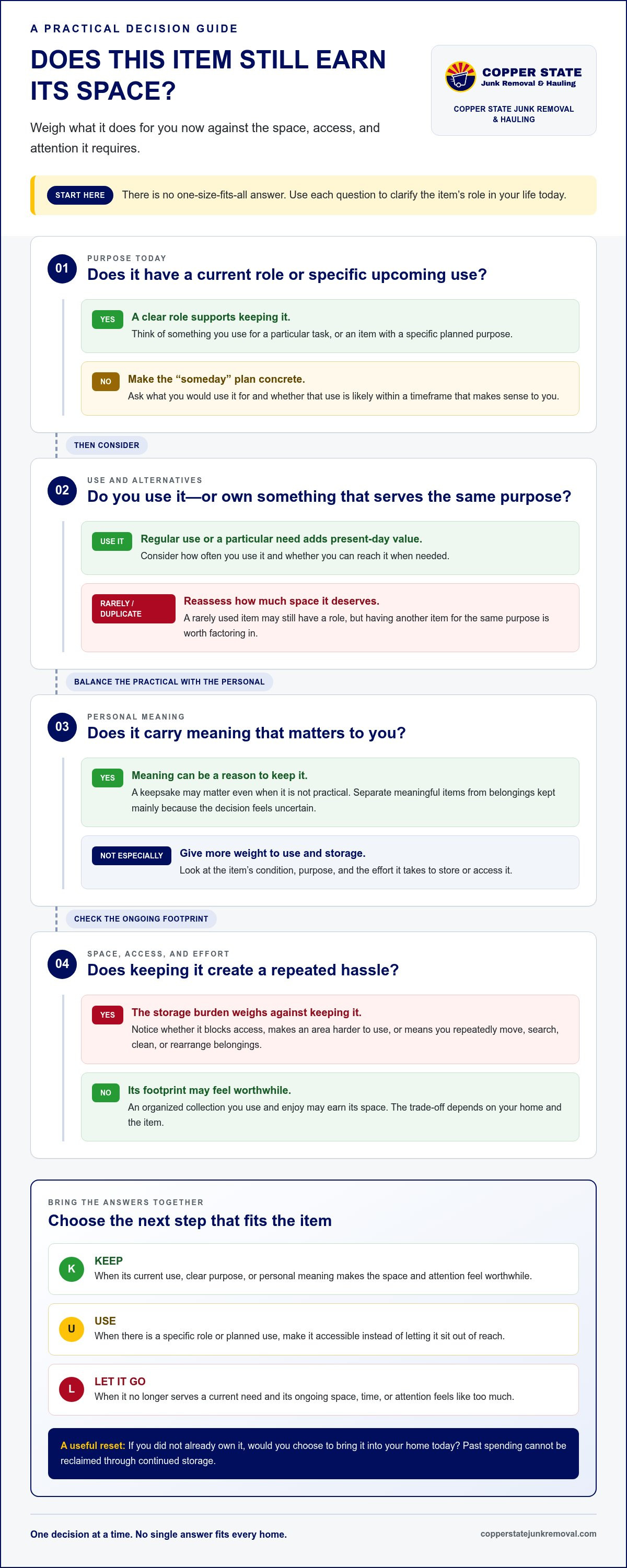
A manageable way to decide what to do with unused belongings
You don’t need to empty an entire home to make progress. A small, repeatable process can help you make clear decisions without turning the task into an all-day project. The Hidden Cost of Keeping Stuff You Don't Use is easier to address one contained area at a time.
Start with one contained space
Choose a drawer, one shelf, or a defined section of the garage. Set a scope that feels realistic for the time and energy you have. Take out the items in that area and separate what you use regularly from belongings with no clear current role. If an item brings up strong feelings, pause rather than pressuring yourself to decide on the spot.
For each item, consider four possible next steps:
- Keep it if it serves a current purpose or matters to you.
- Use it if you have a clear plan to put it to work.
- Give it away if you’re ready to pass it on.
- Remove it if you’ve decided it no longer belongs in your space.
These are options, not rules. Some items may need more thought, and what feels manageable will differ from one person or household to another.
Turn decisions into completed next steps
Give kept belongings a specific, accessible home that suits how you plan to use them. If you keep a tool for regular projects, store it where you can reach it without moving a stack of unrelated boxes. A useful item that stays buried may not be serving you well.
For items you’ve decided to give away or remove, choose a practical next action and follow through when you’re ready. Try not to create another indefinite holding area that simply moves the pile from one corner to another. If your decisions leave you with a larger clear-out than you can comfortably handle, support can be part of the plan.
Progress doesn’t have to mean finishing every room. Complete one small area, notice what works, and choose another manageable spot when it suits you. If unused belongings have grown into a larger clear-out, get help with local junk removal and hauling from Copper State Junk Removal & Hauling, a family-run local business serving Prescott and nearby communities.
When unused stuff calls for a local clear-out
A few unwanted items may be manageable to sort and move on your own. A crowded garage, several bulky belongings, or a larger clear-out tied to a move can be a different kind of job. Sorting is only part of it. Lifting, loading, and coordinating removal add effort, especially when belongings have been stored for a long time or the project already feels emotionally demanding.
The Hidden Cost of Keeping Stuff You Don't Use can include the work of getting those items out of the way. You don’t have to wait until every room is packed to seek help. If the amount to clear feels beyond a comfortable DIY project, hauling can be a practical next step.
Signs a clear-out may be easier with hauling help
Look at the task as a whole. Are large items taking up space you need? Has a garage clean-out grown beyond a few manageable pieces? Are you sorting belongings as part of a move or another property transition? These are situations where handling every part of the clear-out alone may feel like too much. Help with physical removal can leave you more room to focus on decisions and the next stage of the transition.
Take a simple next step toward usable space
Before reaching out, make a short note of the area you want cleared and the belongings you’ve decided can go. You don’t need a perfect inventory. A clear starting point helps turn an overwhelming project into a specific task.
Copper State Junk Removal & Hauling is a family-run local business serving residential and commercial customers in Prescott, Chino Valley, Prescott Valley, Paulden, Dewey, Mayer, Jerome, Clarkdale, Cottonwood, Camp Verde, Verde Valley, and Sedona. Its junk removal and hauling, garage clean-outs, and moving-transition services help with projects that have outgrown a small DIY effort.
Ready to make room to use your space again? Reach out to Copper State Junk Removal & Hauling to discuss your clear-out and take a straightforward next step toward reclaiming the area.
Make room for what matters now
The Hidden Cost of Keeping Stuff You Don't Use is the space, time, and attention belongings continue to claim, not only what they cost when you bought them. Their memories and possible future uses matter too, but they don’t have to make every decision for you. Weigh an item’s current purpose and personal meaning against the room and effort it requires.
Start with one manageable area. Decide what to keep, use, give away, or remove, then take the next step at a pace that feels right. If the clear-out is larger than you can comfortably manage alone, local hauling can help make the work more manageable.
Copper State Junk Removal & Hauling is a family-run local business providing residential and commercial junk removal and hauling in Prescott and surrounding communities, including Chino Valley, Prescott Valley, Paulden, Dewey, Mayer, Jerome, Clarkdale, Cottonwood, Camp Verde, Verde Valley, and Sedona. Take the next step toward a clearer space with Copper State Junk Removal & Hauling. A little more usable room can begin with one thoughtful decision.
Frequently Asked Questions
What is the hidden cost of keeping things you don't use?
The hidden cost is the space, time, attention, and upkeep belongings can continue to require after you bring them home. You may need to move items to reach something else, clean around them, or search stored boxes. The Hidden Cost of Keeping Stuff You Don't Use is different for every household. Consider whether each item’s usefulness or meaning feels worth the space and effort it asks of you.
Can clutter affect how I use space in my home?
Yes. Stored belongings can make rooms, closets, or garages less practical for the things you want to do there. Boxes might block access to tools, or rarely used furniture might take up space you’d prefer to use another way. That doesn’t mean every stored item is a problem. Notice whether belongings prevent you from reaching, using, or enjoying a particular area in your home.
How do I decide whether to keep something I might use someday?
Look for a specific, realistic purpose rather than relying only on “maybe someday.” Ask when you last used the item, whether you have a plan to use it, and whether something else already does the same job. Consider its condition, how easy it is to access, and any personal meaning it holds. Keeping it can make sense if the future use is likely or the item matters to you.
Is it wasteful to get rid of belongings that still work?
Not necessarily. An item can work and still be unused, difficult to store, or no longer useful to your household. If it could serve someone else, you might consider passing it on where practical. You can also keep it if you have a clear use for it or value its presence. The goal isn’t to discard everything that works. It’s to choose what fits your needs and available space.
What should I do with items I feel guilty about letting go?
Pause and identify what’s behind the guilt. An item may carry a memory, represent a gift, or remind you of money spent. You can honor a memory without keeping every object connected to it, but there’s no need to rush. Set meaningful keepsakes apart from belongings you’re unsure about, then revisit those decisions when you feel ready. Your home doesn’t need to meet anyone else’s standard.
How do I start decluttering when the whole house feels overwhelming?
Start with one contained area, such as a drawer, shelf, or part of a garage. Separate items you use from those without a clear current role, then choose a next step for each: keep, use, give away, or remove. Make the task small enough to feel manageable, and pause if a decision feels difficult. You can build on one finished area without taking on the whole house at once.
When should I consider professional junk removal for unused belongings?
Consider hauling help when a clear-out involves bulky items, a crowded garage, or more lifting and loading than you can comfortably manage. Copper State Junk Removal & Hauling is a family-run business serving residential and commercial customers in Prescott, Chino Valley, Prescott Valley, Paulden, Dewey, Mayer, Jerome, Clarkdale, Cottonwood, Camp Verde, Verde Valley, and Sedona. Identify the area or belongings you want cleared to give the project a clear starting point.


