
What’s the simplest way to clear unwanted metal when it’s too heavy or awkward to move yourself? Scrap metal hauling can mean loading and transporting it on your own, or arranging full-service removal so you can avoid the lifting and hauling.
If you’re unsure what to sort, where to take different materials, or how to make pickup easier, a little planning helps. The right option depends on the amount of metal, how accessible it is, and how much work you want to handle yourself.
This guide explains what scrap metal hauling involves and compares self-hauling with full-service removal. You’ll also learn how to sort metal, prepare the pickup area, and share access details that can help the job go smoothly. For bulky metal or a larger property cleanout, full-service hauling takes care of removal and transport. Copper State Junk Removal & Hauling is a family-run local company serving homes and businesses in Prescott, Prescott Valley, Chino Valley, Paulden, Dewey, Mayer, Jerome, Clarkdale, Cottonwood, Camp Verde, Verde Valley, Sedona, and nearby communities. With a clear plan, you can reclaim space without taking on more lifting than you need to.
Key Takeaways
- Scrap metal hauling removes and transports unwanted metal; it doesn’t automatically mean selling it or guaranteeing recycling.
- Recognize broad metal categories, but don’t assume a material’s value or whether a scrap yard will accept it.
- Choose between self-hauling, a scrap-yard drop-off, and full-service hauling based on the load, lifting involved, access, and time you have.
- Make pickup smoother by identifying items, checking access, clearing a route, and sharing useful project details.
- Copper State Junk Removal & Hauling serves residential and commercial customers in Prescott, Prescott Valley, Chino Valley, and nearby Central Arizona communities.
What Scrap Metal Hauling Covers, and When It Can Help
Scrap metal hauling means removing unwanted metal from a property and transporting it away. It can be part of a garage clear-out, renovation cleanup, or a larger effort to clear a home or business. The goal is to remove items from the property, not to promise payment or a particular recycling outcome.
Scrap metal hauling is the removal and transport of unwanted metal from a property, with handling shaped by the items and the job. A hauling service differs from selling metal to a scrap yard. A scrap yard may assess material for purchase, while a hauler provides removal and transport. These are separate steps, and hiring a hauler doesn’t guarantee that the metal will be recycled. For a general overview of scrap materials and recycling, see What is Scrap Metal?
What kinds of unwanted metal might a cleanout involve?
A cleanout may uncover metal shelving, furniture frames, old fixtures, or renovation offcuts. The item’s condition, size, and location all affect how it can be handled. A narrow doorway, bulky shape, or piece tucked behind stored belongings can make removal more involved than its weight alone suggests.
Keep unusual materials separate from ordinary household metal. If an item may contain hazardous substances or has parts you can’t identify, don’t assume it belongs in a routine metal load. Pause and determine the appropriate handling before including it in a pickup plan. This keeps the job focused on items that can be safely moved as part of the cleanout.
When is hauling more practical than moving metal yourself?
A few small, easy-to-carry pieces may be manageable if you have suitable transport and a clear route. A pile of bulky shelving or heavy fixtures is a different job. Stairs, a long walk to the vehicle, awkward turns, and limited cargo space all add effort and may mean extra trips. Consider the entire move, not just whether you can lift an item once.
- Consider the load: Several large or awkward items can be difficult to carry and secure for transport.
- Check the route: Stairs, tight access, or a long path to the vehicle can make self-loading harder.
- Look at the full project: If a garage, renovation area, or business space also contains other unwanted items, include them in a broader cleanout plan to clear the area in one organized effort.
Full-service hauling is worth considering when lifting and transport are the main obstacles, especially during a larger property cleanout. It reduces the work you need to do yourself. For a small amount of manageable metal, self-transport may be more straightforward. Match the approach to the load, access, and effort involved.
Identify Scrap Metal and Plan for Safe, Practical Handling
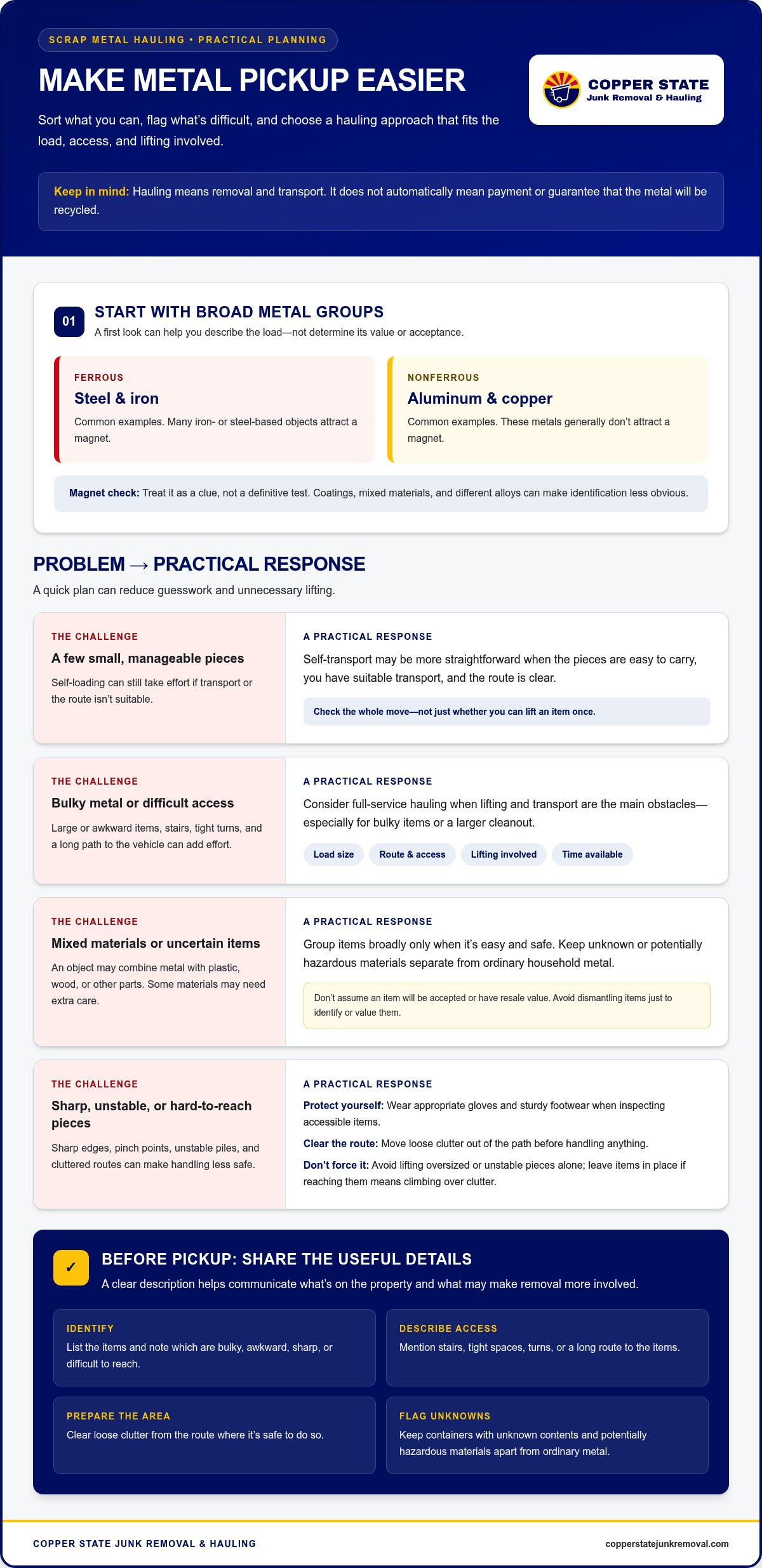
Sorting metal before a cleanout can help you describe what needs to be moved and identify items that need extra care. Two broad categories are ferrous and nonferrous metals. Steel and iron are common ferrous examples; aluminum and copper are common nonferrous examples. These categories help organize a load, but they don’t determine whether a particular item will be accepted or have resale value.
Ferrous metals generally contain iron, while nonferrous metals generally do not. This distinction is useful for a first look, not a complete material identification. A magnet can offer a clue, but it isn’t a definitive test for every metal or alloy.
How can you tell common metal types apart?
Try a magnet only on items you can reach safely. Many iron- or steel-based objects attract a magnet, while aluminum and copper generally don’t. Coatings, mixed materials, and different alloys can make identification less obvious. A painted fixture or metal-framed object may also include plastic, wood, or other parts, so its appearance alone may not tell you exactly what it contains.
Separate items into broad groups if doing so is easy and safe. This gives you a clearer picture of the load and helps you explain what’s on the property. Don’t spend time dismantling an item or guessing its worth. Sorting helps you understand the materials, but it doesn’t promise payment or guarantee that every piece will be accepted for recycling.
What safety steps should you take before moving metal?
Metal can have sharp edges, pinch points, or an uneven shape that shifts as you handle it. A stack that looks stable may move when you pull away one piece. Assess the item and its surroundings before touching it. If you can’t reach it without climbing over clutter or disturbing an unstable pile, leave it in place and include its location in your cleanout plan.
- Protect yourself: Wear appropriate gloves and sturdy footwear while inspecting accessible items.
- Keep the route open: Clear loose clutter from the path before moving anything. Don’t lift oversized or unstable pieces alone.
- Separate unknowns: Keep containers with unknown contents and materials that may be hazardous apart from ordinary metal. Don’t open or combine them with the load.
- Describe the difficult pieces: Note sharp edges, awkward shapes, stairs, or tight spaces so the handling needs are clear.
Good preparation doesn’t mean taking apart every object or carrying heavy pieces to a more convenient spot. Identify what’s accessible, flag what isn’t, and avoid unnecessary lifting. For a larger cleanout with bulky items, property cleanout hauling can help clear the space without requiring you to move every item yourself.
Compare Self-Hauling, Scrap-Yard Drop-Off, and Full-Service Hauling
The best option depends on more than how much metal you have. Consider how awkward the items are, whether you have suitable transport, how far they need to travel, and how much of the work you want to take on. A small, manageable load is very different from bulky pieces spread between a garage and a yard.
- Self-hauling: You handle the lifting, loading, transport, and unloading. It can suit a few easy-to-carry items if you have an appropriate vehicle and time for the trip.
- Scrap-yard drop-off: You take the metal to a yard, where acceptance, sorting, and operating requirements may vary. Drop-off doesn’t guarantee that the yard will accept the load, pay for it, or recycle it.
- Full-service hauling: A hauling team handles removal and transport, reducing the lifting and vehicle logistics you manage yourself.
Think through each step, not just the drive. Loading and unloading take effort, and an undersized vehicle may mean multiple trips. If you’re comparing a service quote with a DIY plan, junk removal pricing factors can help explain what may shape a broader cleanout estimate.
When might self-hauling or drop-off suit the job?
Self-hauling or scrap-yard drop-off may work well for a small load that’s easy to lift and secure, especially if you already have suitable transport. Before setting out, review the destination’s operating hours and requirements so you know how it handles incoming material. Allow time for sorting, loading, the drive, unloading, and any return trips. The work can add up even when the load looks modest.
When can full-service hauling make the task easier?
Full-service hauling can be a practical choice if metal is bulky, there’s a lot of it, or it’s spread across several parts of the property. It can also simplify a cleanout that includes other unwanted household or business items, rather than leaving you to arrange separate trips for each category. Consider how much lifting and transport you want to manage. Comparing the effort with the convenience can help you decide.
For scrap metal hauling, choose the approach that fits the job you have. If you can move a few pieces safely and transport them in one trip, doing it yourself may be straightforward. If the load requires difficult lifting, repeated trips, or clearing several spaces at once, full-service hauling can take that work off your hands.
Prepare Scrap Metal for Pickup at a Central Arizona Property
A little preparation can make a pickup easier to plan without requiring you to haul heavy items to the curb. Start by identifying what needs to go, then consider how it can be reached and moved. A garage in Prescott Valley, a yard in Chino Valley, a renovation area in Prescott, or a commercial space in another Central Arizona community may each have different access needs.
- Identify the items. Make a simple list of the metal pieces and any other unwanted items included in the cleanout.
- Assess access. Note where items are located and whether stairs, narrow gates, uneven ground, or tight turns affect the route.
- Clear a safe path. Move unrelated belongings out of the way when practical, without shifting heavy or unstable items.
- Share the project details. Describe the load, location, and access constraints so the pickup can be planned around the property.
Don’t stage metal where it blocks a driveway, exit, or shared access route. Keep it in a safe, accessible spot instead. If it can’t be moved safely, leave it where it is and explain its location.
What details help describe the load?
A useful description doesn’t need technical metal names. Note the approximate item count, general size, and where each group is located, such as along a garage wall, beside a yard shed, near a renovation area, or inside a commercial unit. Mention stairs, narrow gates, uneven ground, and other obstacles that could affect access or handling.
Clear photos can help show the items and the route, as long as you can take them safely. A view of the full load and a separate view of a tight passage may communicate more than a close-up alone. Don’t climb over clutter or approach an unstable stack for a better picture.
How can you make the pickup area easier to work in?
Where practical, move unrelated belongings away from the path between the metal and the access point. Leave room to move through the area, and keep children and pets away from active loading zones. Don’t dismantle or reposition oversized pieces just to make them easier to see.
Storm or property-damage cleanup may involve more than metal. Broken fixtures, building materials, and other debris can be mixed together, so describe the broader project rather than treating every item as scrap. Copper State also provides disaster recovery cleanup in Prescott and other Central Arizona communities.
Ready to clear bulky metal as part of a home or business cleanout? Arrange property cleanout hauling with Copper State Junk Removal & Hauling, a family-run local company serving Central Arizona communities.
Arrange Scrap Metal Hauling with Copper State Junk Removal & Hauling
Heavy metal doesn’t have to become a do-it-yourself moving project. Copper State Junk Removal & Hauling provides scrap metal hauling for residential and commercial customers across Central Arizona, including Prescott, Prescott Valley, Chino Valley, Paulden, Dewey, Mayer, Jerome, Clarkdale, Cottonwood, Camp Verde, Verde Valley, and Sedona. If metal is part of a larger property cleanout, sharing the full scope helps shape a practical removal plan.
You don’t need to identify every alloy or move items into a pile before describing the job. Start with what you know: what needs to go, where it is, and what could make access difficult. A clear overview helps set expectations and keeps the plan grounded in the property and the work involved.
What happens when you request a hauling service?
Describe the project type, approximate load, and where the items are located. For example, say whether the metal is in a garage, outside in a yard, near renovation work, or spread through a commercial space. Include useful access details, such as stairs, a narrow gate, uneven ground, or a route that needs to stay open for others.
The project’s scope shapes the hauling plan. A few accessible pieces in one area may call for a different approach than numerous bulky items spread across a property alongside other unwanted belongings. Photos can help show the layout when you can take them safely, but don’t rearrange heavy items or put yourself at risk for a better view. Share the details you have, and leave difficult items where they are.
Which Central Arizona projects can benefit from hauling?
At home, unwanted metal may be part of clearing a crowded garage or making room after renovation work. At a business, fixtures or other unwanted items may be taking up space needed for daily use. Looking at the whole project, rather than treating each piece as a separate trip, can make it easier to plan a cleanout and reclaim useful space.
Copper State serves residential and commercial customers in Prescott, Prescott Valley, Chino Valley, Paulden, Dewey, Mayer, Jerome, Clarkdale, Cottonwood, Camp Verde, Verde Valley, Sedona, and nearby Central Arizona communities. The family-run company handles hauling and property clearing. The goal is to remove the items identified in the project, not to promise payment for metal or a particular recycling outcome. Describe the property and access honestly, including anything that could affect safe handling, so the job can be planned around those conditions.
If unwanted metal is part of a garage clear-out, renovation cleanup, or business property clearing, take the next step when you’re ready. Request scrap metal hauling and share what needs to be removed, where it’s located, and any access details that matter.
Make Room for What Comes Next
Clearing metal isn’t only about getting bulky items out of the way. It can be the first step toward using a garage for parking again, making a renovation area easier to work in, or opening space for daily operations. Before arranging scrap metal hauling, picture what you’d like to do with the space afterward. That goal can help you decide what belongs in the project and which details matter most for pickup.
Copper State Junk Removal & Hauling is a family-run local business providing residential and commercial hauling across Central Arizona. Share what you want removed and the access details that shape the job. You don’t need to have every item perfectly sorted before getting started. A clear description is a practical first step, and noting your main priority can help keep the project focused.
Tell Copper State about your scrap metal hauling project, and take a step toward a clearer, more usable property.
Frequently Asked Questions
What items can be included in scrap metal hauling?
Cleanout loads may include items such as metal bed frames, shelving, filing cabinets, old fixtures, or leftover pieces from a home project. These examples don’t mean every item can be handled the same way. Attached materials, condition, size, and location can affect removal planning. Describe unusual or partly assembled objects clearly so the load is understood before moving anything.
Can I put different types of scrap metal in the same load?
Different metals may be gathered in one project, but a single mixed pile isn’t always the most useful way to organize them. If you’re taking material to a scrap yard, its sorting rules may determine how to prepare the load. For a property pickup, keeping visibly different groups identifiable can help explain what’s there. Don’t spend time separating pieces that are attached or difficult to move safely.
Do I need to remove plastic, wood, or other materials from scrap metal?
Not necessarily. A metal chair with a fabric seat or a fixture with attached parts may be awkward or unsafe to dismantle, so don’t take it apart just to make it look like pure metal. If a nonmetal piece comes away easily and safely, keeping it separate can make the items clearer. Scrap yards may have their own preparation rules, so don’t assume every destination handles mixed materials alike.
Is scrap metal hauling the same as scrap metal recycling?
No. Scrap metal hauling is about removing metal from a property and transporting it. Recycling is a separate processing outcome, and arranging hauling doesn’t guarantee that an item will be recycled. If your main goal is recycling, distinguish that from simply clearing space when planning your next step. For a cleanout, focus first on describing what needs removal and where it is, rather than assuming a particular destination.
Can scrap metal be picked up from a garage or backyard?
Metal may be located in places such as a garage or backyard, and its location helps shape the pickup plan. A crowded garage, a narrow side gate, or a backyard reached by an uneven path can affect access. Describe how the area is reached and whether other belongings are nearby. Don’t move heavy pieces into a driveway or shared route just to make them easier to see.
How should I describe a scrap metal load when requesting hauling?
Give a simple picture of the job: name the main items, estimate how many there are, describe their general size, and say where they’re located. Mention whether the load is stacked, spread across rooms, or mixed with other cleanout items. Note stairs, gates, or other access limitations. If safe, photos showing both the items and their route can add useful context without requiring you to move anything.
Does Copper State Junk Removal & Hauling serve Prescott and Prescott Valley?
Yes. Copper State serves Prescott and Prescott Valley, along with Chino Valley, Paulden, Dewey, Mayer, Jerome, Clarkdale, Cottonwood, Camp Verde, Verde Valley, Sedona, and nearby Central Arizona communities. The family-run company handles residential and commercial hauling and property clearing. When describing a project, include the community, the metal’s location, and any access details so the request reflects the property and the work involved.


