

What if the best way to clear a crowded Prescott property is to make fewer, more consistent sorting decisions? If you’re asking, “Recycle or Throw Away During a Cleanout?” start with each item’s condition, material, and local acceptance rules. This quick check can help keep usable belongings and accepted recyclables out of the trash.
A packed garage, home, or estate can make sorting feel like a big job. Recycling rules also vary by location: Prescott residents and people outside city limits may have different collection options. Before setting items at the curb or loading them for disposal, find out what the destination accepts and how items need to be prepared.
This guide explains how to decide what to keep, donate, recycle, or discard, including what to do with common materials and items that don’t belong in ordinary recycling bins. You’ll learn why condition and location matter, and how to plan for the items that remain. When the sorting is done, Copper State Junk Removal & Hauling provides residential and commercial cleanouts and hauling to help clear the space.
Key Takeaways
- To decide “Recycle or Throw Away During a Cleanout?” sort items by condition and material, then confirm that a local program accepts them.
- Clean, functional belongings may be better candidates for donation or resale than damaged items.
- Check current city, county, and facility guidance before setting aside paper, cardboard, metal, plastics, or electronics for recycling.
- A room-by-room checklist helps organize decisions and plan the final load without making the cleanout feel overwhelming.
- When the remaining haul is large, heavy, or time-consuming, professional cleanout and hauling help can make clearing the space easier.
Recycle or Throw Away During a Cleanout? Start With a Four-Way Sort
Before discarding an item, check its condition, identify its material, and find out whether a local collection program or facility accepts it. A material may be recyclable in general but lack a convenient local route. A cleanout sorting decision means choosing an item’s next destination based on what it is, what shape it’s in, and what local programs accept.
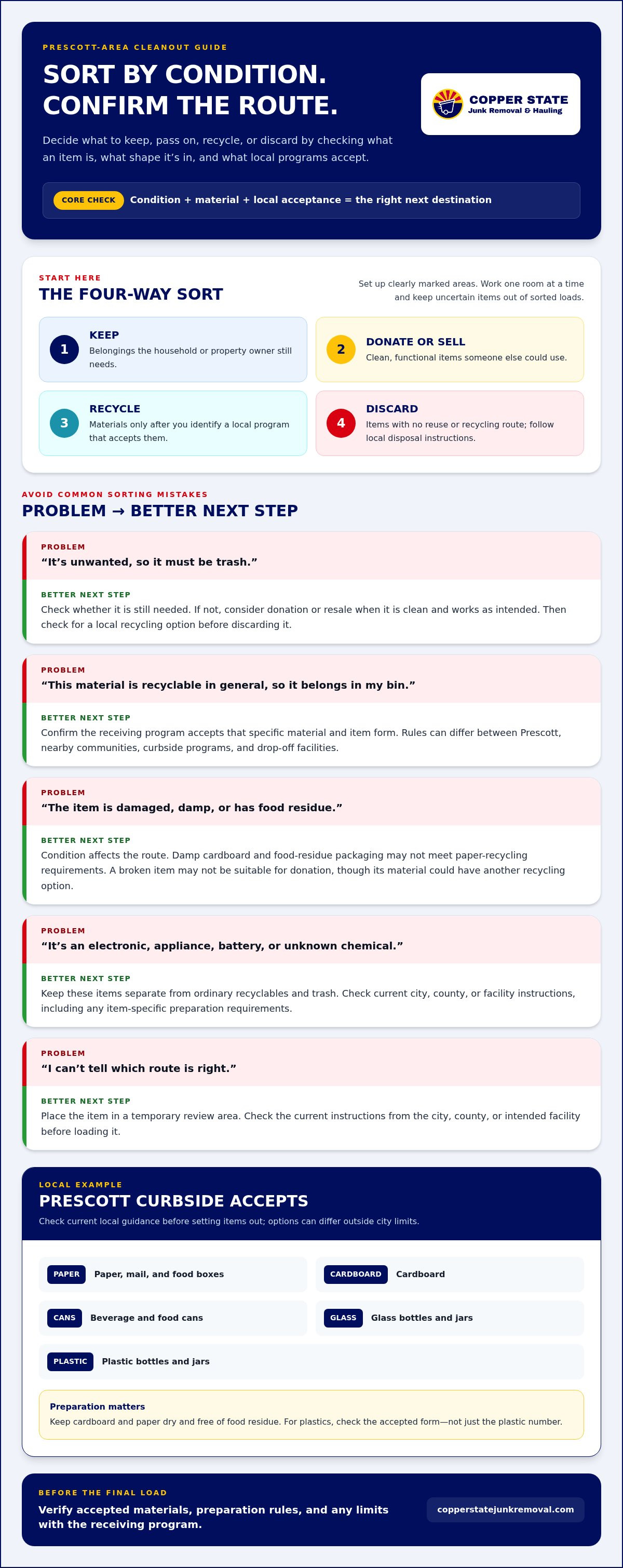
Set up four clearly marked areas: keep, donate or sell, recycle, and discard. Keep belongings the household or property owner still needs. Set aside clean, functional items someone else could use. Put materials in the recycling area only after identifying a local option that accepts them. For items with no reuse or recycling route, follow local disposal instructions.
This four-way sort makes Recycle or Throw Away During a Cleanout? easier to answer without treating every unwanted item as trash. Recycling involves collecting and processing materials for reuse, but that doesn’t mean every program accepts every material. The overview of Recycling explains the general process. For a cleanout, the receiving program’s rules determine what belongs in its stream.
How to make a fast keep, donate, recycle, or discard decision
Work one room at a time and begin by asking whether the household needs the item. Keep what is still needed or belongs with the property. If an item is clean and works as intended, consider donation or resale. For everything else, identify its main material and look for a local recycling route before adding it to that pile. If you’re unsure, put it in a temporary review area. That prevents a questionable item from contaminating a sorted load.
Why condition and local acceptance matter
Condition affects an item’s best route. Damp cardboard may not be suitable for paper recycling, and food residue can make a container unacceptable. A broken item may no longer be useful for donation, though its material could have a separate recycling option. Mixed-material items can be harder to sort, especially when their components cannot be separated easily.
Acceptance also varies by program. A drop-off facility may accept something that does not belong in curbside recycling, and rules can differ between Prescott and nearby communities. Before loading your vehicle, check the current instructions from the city, county, or facility you plan to use. Confirm the accepted material, preparation requirements, and any limits. If the rules don’t clearly cover the item, keep it out of the recycling load until you know its route.
What Can You Recycle During a Central Arizona Cleanout?
Start with materials that may have a local recycling route, then check the rules for the specific city, county, or facility. Prescott’s curbside program accepts cardboard, paper, food boxes, mail, beverage and food cans, glass bottles and jars, and plastic bottles and jars. Options can differ outside city limits, so don’t assume a curbside rule applies to a transfer station or another community.
A material is recyclable locally only when the receiving program accepts it in its current condition. The answer to “Recycle or Throw Away During a Cleanout?” depends on both what an item is made of and where you plan to take it.
Metal, cardboard, paper, and plastic
Keep metal separate from mixed debris so you can check whether the intended facility takes it. Cardboard and paper should be dry and free of food residue. Greasy or damp packaging may not meet the program’s requirements. Plastic needs a closer look, too. Prescott’s curbside guidance focuses on accepted bottle and jar forms, not a plastic number alone, so don’t assume every plastic container or product can go in the same bin.
| Item | Condition | Possible route | Acceptance check |
|---|---|---|---|
| Metal cans or scrap | Separated from mixed debris | Curbside collection or a local drop-off, depending on the item | Confirm the program accepts that type and size of metal |
| Cardboard and paper | Clean, dry, and free of food residue | Curbside collection or a designated recycling location | Check material and preparation rules |
| Plastic containers | Empty and prepared as directed | Accepted curbside items or a facility route | Check the specific form of plastic, not just its number |
| Electronics and appliances | Kept separate from ordinary recyclables | A local collection or facility with an appropriate route | Verify accepted items, preparation, and special instructions |
Electronics, appliances, and other special materials
Set electronics aside rather than putting them in a curbside recycling bin. Look up current local e-waste instructions before transporting them. For appliances, confirm whether the facility accepts the specific item and whether it has preparation or refrigerant-related requirements. Keep batteries and unknown chemicals separate, too. Follow current city or county instructions for their handling rather than putting them in ordinary trash based on guesswork.
Before loading the vehicle, check the current instructions from your city, Yavapai County, or the receiving facility. If the cleanout includes bulky items or mixed debris, residential cleanout hauling from Copper State Junk Removal & Hauling can help with the property-clearing work. Recycling destinations depend on the receiving program, so sort those items separately.
Donate, Reuse, or Throw Away? Match the Route to the Item
After separating possible recyclables, look at the remaining belongings one at a time. Clean, complete, functional items are generally stronger candidates for reuse than damaged or contaminated ones. Then consider the effort involved: donation or resale takes preparation and coordination, recycling requires an accepted route, and disposal may be the practical choice when an item has little recovery potential.
Use condition as your first screen, not the item category alone. A sturdy chair in usable condition may be worth offering for reuse; a broken one may not be. Clean clothing, kitchenware, and working tools could also be donation or resale candidates, but acceptance depends on the destination. Review its current guidelines before packing or arranging a handoff. For local ideas, see this Prescott household donation guide.
Which cleanout items may be better to donate or sell?
Check four things: cleanliness, condition, completeness, and likely usefulness. Are all the parts there? Does the item work as intended? Is it ready for another person to use without extensive cleaning or repair? If so, donation or resale may be worth considering. Selling takes time for photos, messages, and pickup arrangements, so focus on belongings with enough value to justify that effort. This guide to items to sell before a Prescott cleanout can help you decide what merits listing.
- Donate: Consider clean, useful belongings when a local organization’s guidelines fit the item.
- Sell: Set aside complete, functional items that may justify the time required to list and transfer them.
- Recycle: Use this route when the material and item condition match a local program’s acceptance rules.
- Dispose: Choose this route for items with no practical reuse option, while following applicable handling instructions.
When does throwing an item away make sense?
Broken, heavily stained, contaminated, or incomplete belongings may have fewer reuse options. Don’t let a vague hope that someone might want them delay the cleanout. If an item has special handling instructions, however, don’t assume ordinary trash is appropriate. Check current local guidance before setting it aside for disposal.
Keep personal papers, financial records, photographs, and other sensitive belongings separate from the general piles. Review them carefully before deciding what to keep or remove. A short pause can protect important information and prevent a rushed cleanout decision from becoming a lasting regret.
A Prescott-Area Cleanout Checklist for Local Recycling and Disposal
A clear sequence keeps a cleanout from turning into piles that need to be sorted twice. Work through one room at a time, and confirm local instructions before deciding where materials will go. Services and accepted materials can vary by municipality and facility across Prescott, Prescott Valley, and the Verde Valley.
Where to verify recycling and disposal options near Prescott
Start with current guidance from Yavapai County, the relevant city or town, and the facility you plan to use. These are places to verify options, not a guarantee that a particular material or item will be accepted. Before loading, check accepted materials, preparation requirements, operating hours, and any instructions for special items. Rules can change, so use the destination’s latest information rather than an old list or a neighbor’s experience.
A cleanout sequence that keeps sorting manageable
- Choose one room. Finish sorting its contents before moving to the next space. You’ll see what remains and reduce the chance of overlooking useful belongings.
- Mark four areas. Label them keep, reuse, recycle, and discard. Put items with no clear destination in a separate review area instead of guessing.
- Separate by material and item type. Keep potential recyclables together only after identifying a plausible local route. Set electronics and potentially hazardous or unknown materials apart from ordinary household discards.
- Check destination instructions. Compare each review pile with current city, county, and facility guidance. Note preparation steps and operating hours so you don’t arrive with a load the destination can’t accept.
- Plan the final load. Group items by destination and keep uncertain items out of confirmed loads until you understand their instructions. This helps avoid a last-minute reshuffle.
If you’re still deciding what to Recycle or Throw Away During a Cleanout?, pair each item with a confirmed local route before loading it into a vehicle. For more planning guidance, read this Central Arizona house cleanout guide.
Once you’ve decided what to keep, reuse, and recycle, a large remaining load can still take time and effort to move. Arrange cleanout hauling help from Copper State to make the final property-clearing step easier.
Finish the Cleanout Without Guesswork: Handle the Remaining Haul
After setting aside belongings to keep, reuse, or recycle, the remaining load can still be the hardest part. Hauling help can be useful when rooms are full, items are bulky or heavy, or repeated trips would take time you don’t have. Moving transitions and demanding property clear-outs can also leave more to remove than a household can comfortably manage alone.
When professional junk removal can make the final step easier
Removing unwanted belongings takes planning and physical effort, especially when a cleanout involves multiple rooms or large items. Copper State Junk Removal & Hauling is a family-run provider of residential and commercial cleanouts across Central Arizona. Its hauling service handles the physical work of removing belongings, helping you move from a sorted property toward a cleared one. For a transition involving a move to assisted living, see this Central Arizona assisted living cleanout guide.
Keep special or uncertain materials separate and follow current local handling instructions. Paint, chemicals, batteries, and other materials with special requirements need the appropriate handling route. Your sorting work clarifies what remains for a cleanout haul and what needs separate handling.
Plan a practical next step for your cleanout
Make a short list of the areas that still need attention and the main items to clear. Note whether you’re dealing with a full room, bulky belongings, or a move-related cleanout. This gives you a clear starting point and helps keep the remaining task manageable. Copper State serves Chino Valley, Prescott, Prescott Valley, Paulden, Dewey, Mayer, Jerome, Clarkdale, Cottonwood, Camp Verde, the Verde Valley, and Sedona.
You’ve already done the careful work of sorting. Let Copper State help with the remaining property clearing so you can focus on what comes next. Arrange cleanout hauling help and take the next step toward a cleared property.
Turn Your Sorting Decisions Into a Clear Space
A smoother cleanout starts with a simple habit: judge each item by its condition, material, and the local destination’s rules. Clean, useful belongings may be better suited to reuse, while recycling depends on what nearby programs accept. If you’re still asking, “Recycle or Throw Away During a Cleanout?” keep uncertain items separate until you’ve checked their proper route.
Then focus on what remains. Bulky belongings, full rooms, and move-related clear-outs can be hard to manage alone. Copper State Junk Removal & Hauling is a family-run local business providing residential and commercial cleanouts, including garage cleanouts, moving transitions, and hoarder cleanups.
You’ve already made the careful decisions. Let a local team help with the remaining haul and move the property toward clear. Get help clearing the items left after sorting. One room at a time, you can turn a crowded space into a fresh start.
Frequently Asked Questions
Can I recycle everything that has a recycling symbol?
No. A recycling symbol doesn’t guarantee that a local program accepts an item. Acceptance may depend on its material, condition, size, and the facility receiving it. Check current Yavapai County, municipal, or facility instructions before setting items aside. Keep materials clean and separated as required, and choose another suitable route when local guidance excludes them. Don’t assume curbside collection rules apply to every drop-off location.
What items are most commonly recyclable during a cleanout?
Metal, clean cardboard and paper, and some electronics or plastics may have recycling options, but local acceptance varies. Separate them from mixed debris and check the destination’s current rules before transporting them. Some items require special collection, preparation, or a dedicated program. Don’t assume an item is accepted simply because it can be recycled elsewhere. Confirm the local route first, especially around Prescott, Prescott Valley, and other Yavapai County communities.
Should I donate or recycle furniture during a cleanout?
Start with the furniture’s condition. Clean, complete, usable pieces may be candidates for donation or resale, depending on the receiving organization’s current guidelines. Broken, heavily stained, or damaged furniture may not be suitable for reuse, and a whole piece isn’t automatically recyclable. Check local options before arranging a drop-off. Separate removable materials only if a receiving program accepts them, and follow its preparation instructions.
Can electronics go in the regular trash in Arizona?
Don’t assume electronics belong in ordinary trash in Arizona. Devices may need a dedicated collection or recycling route, and local programs set their own instructions. Check current Arizona, Yavapai County, municipal, or facility guidance for the specific device. Keep batteries or damaged electronics separate if instructions call for special handling, and don’t dismantle unfamiliar equipment. For a Prescott-area cleanout, confirm the destination’s rules before loading.
What should I do with paint, chemicals, or batteries during a cleanout?
Keep paint, chemicals, batteries, and other potentially hazardous materials separate from ordinary household debris. Don’t pour liquids down drains or put uncertain materials in regular trash based on guesswork. Check current official Arizona and local instructions for the specific item, packaging, and drop-off process. Follow the appropriate handling route before finishing the cleanout.
How do I find out what Prescott-area facilities accept?
Check current information from Yavapai County, the relevant municipality, and the specific facility before loading your vehicle. To decide “Recycle or Throw Away During a Cleanout?”, confirm accepted materials, condition requirements, preparation steps, hours, and current restrictions. Rules can vary by destination and change over time. Prescott, Prescott Valley, and nearby communities may have different options. If instructions are unclear, keep the item separate until you find official guidance.


