

A donation can turn into an unnecessary trip if a thrift store can’t accept what’s in your vehicle. Before you load up to Donate, confirm that your items match the organization’s current needs.
If you’re sorting household belongings in Prescott, it’s natural to wonder where usable items can go and what each place will take. A quick check of accepted items, drop-off hours, and appointment rules can save time and help your donations reach a useful next stop.
This guide covers local options, including Stepping Stones Thrift, Prescott Area Habitat for Humanity ReStore, DAV Chapter 16, and St. Vincent de Paul. You’ll learn how to prepare clean, usable items, verify details before leaving, and make a practical plan for belongings that can’t be donated. Recycling, local disposal options, or professional hauling may fit what’s left, depending on the item.
Key Takeaways
- Match belongings to their condition: prioritize clean, complete, working items and set aside damaged or unsafe items.
- Look for donation options in Prescott and nearby communities, then confirm current policies directly with each organization.
- Before you Donate, sort items into confirmed donations, items awaiting an answer, and belongings that need another plan.
- Clean and pack accepted items safely, and follow the organization’s directions for drop-off or appointments.
- If an item is declined, check for another suitable reuse option before choosing an appropriate disposal route.
Where to Donate Household Items in Prescott: Start with the Right Local Option
Sorting a home can feel like a job with no clear finish line. Start by matching usable belongings with a local recipient, then verify the details before loading the car. Donation routes may include thrift stores, charitable organizations, reuse groups, or a direct handoff to someone in the community. Each route has its own rules, so don’t assume a location accepts every household item.
Physical goods are different from monetary gifts. A cash donation supports an organization financially; a household donation gives it an item that may be resold, reused, or passed along. For a neutral overview of what a donation is, see the general definition. Here, the focus is on finding a responsible destination for usable belongings.
Which kinds of local donation routes should you look for?
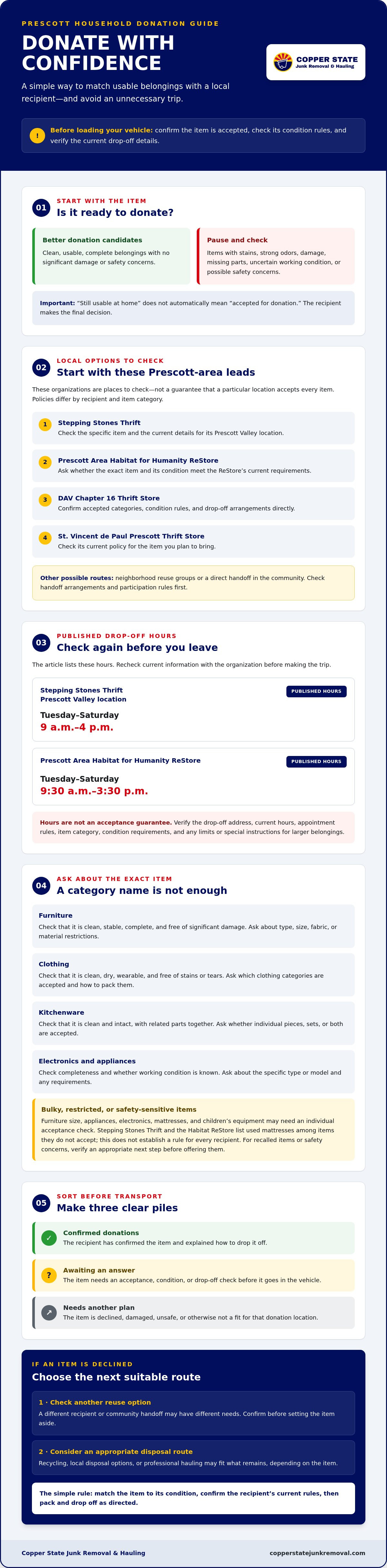
Start with established thrift and charity locations serving Prescott and nearby communities. Options to check include Stepping Stones Thrift, Prescott Area Habitat for Humanity ReStore, DAV Chapter 16 Thrift Store, and St. Vincent de Paul Prescott Thrift Store. These are leads, not a guarantee that a particular branch can accept your items. Neighborhood reuse groups may also help, but check their handoff arrangements and participation rules before setting goods aside.
Match the route to the item. A thrift store may have different needs from a reuse group or charitable organization. Ask whether it accepts the specific category, such as furniture, kitchenware, clothing, or appliances, and describe the item’s condition. A general “household goods” policy may not cover every individual item.
How can you check whether a donation location is current?
Use the organization’s own website or contact it directly rather than relying on an old directory entry or social post. Confirm the actual drop-off address, current hours, and whether you need an appointment. Ask about accepted categories, condition requirements, and any limits or special instructions for larger belongings.
Published information lists donation drop-off hours at Stepping Stones Thrift’s Prescott Valley location as Tuesday through Saturday, 9 a.m. to 4 p.m., and at the Prescott Area Habitat for Humanity ReStore as Tuesday through Saturday, 9:30 a.m. to 3:30 p.m. Recheck these details before leaving, and confirm that your item is welcome. Call or check the recipient’s official information if anything is unclear.
Keep the rule simple: donation policies vary and can change. Confirm the current location, accepted items, condition rules, and drop-off process with the recipient. Donate only after you know where the item is going and how the organization wants to receive it.
What Can You Donate in Prescott? Match Each Item to Its Condition
An item may still work for you and not meet a donation center’s needs. Check its condition first, then confirm that the recipient accepts that category. Clean, usable, complete belongings are better candidates than items with stains, damage, missing parts, or safety concerns, but the organization makes the final call.
How do you decide whether an item is donation-ready?
Give each item a quick, honest inspection. Look for visible damage, strong odors, stains, missing pieces, and signs that it may not work as intended. For powered items, ask whether the recipient accepts them and expects you to confirm they work. Don’t assume that “still usable at home” means “ready to donate.”
Policies can differ even within the same category. For example, the Prescott Area Habitat for Humanity ReStore and Stepping Stones Thrift list used mattresses among the items they don’t accept. That doesn’t establish a rule for every local recipient, so ask about the exact item before arranging transport.
Which items need a specific acceptance check?
Furniture size, appliances, electronics, mattresses, and other bulky belongings can have restrictions that aren’t obvious from a general donation policy. Check children’s equipment individually, too. Ask whether the recipient accepts the specific item and whether it has condition or safety requirements. If you’re unsure about a recalled item or one with a safety concern, don’t offer it until you’ve verified an appropriate next step.
| Item category | Condition to check | Questions for the recipient |
|---|---|---|
| Furniture | Clean, stable, complete, and free of significant damage | Do you accept this type and size? Are there fabric or material restrictions? |
| Clothing | Clean, dry, wearable, and free of stains or tears | Do you accept this clothing category, and how should it be packed? |
| Kitchenware | Clean, intact, and complete where parts belong together | Do you take individual pieces, sets, or both? |
| Electronics and appliances | Complete, with working condition known if possible | Do you accept this model or type? Must it be tested or disconnected? |
| Children’s items | Clean, complete, and without known safety concerns | Do you accept this item, and are there specific safety restrictions? |
Set aside anything damaged, unsafe, or declined rather than mixing it with confirmed donations. The EPA offers guidance to help people properly dispose of non-donatable items, including considering recycling where suitable. If bulky belongings remain after sorting, you can review options for mattress removal as a separate next step. Donate only what the recipient has confirmed it can take.
How to Find and Verify Donation Options Around Prescott
Use the same check-before-you-go process whether you’re looking in Prescott, Prescott Valley, Chino Valley, or another nearby community. Search for a specific item and town, then visit the recipient’s official website or contact it directly. Old directory listings and shared posts can help you find a lead, but they may not reflect current hours or donation rules.
An online listing is a lead, not confirmation that your item will be accepted. Confirm the exact item, its condition, and how many you plan to bring. Policies may vary by location, so a general statement that an organization accepts household goods may not answer whether it can take your particular belongings.
What should you ask before making a donation trip?
Be specific. Describe the item, its size and condition, and the quantity. Then confirm whether the location accepts it and whether you can drop it off, need an appointment, or should ask about pickup availability. Pickup may not be offered at every location.
For bulky belongings, ask where to unload and whether staff can help. Don’t assume a donation site has space or assistance available. Before setting out, confirm the correct address and current hours for the donation area, which may differ from the store’s hours.
How can you compare options across Central Arizona?
Compare more than driving distance. A nearby location that can’t accept the item won’t save you a trip. Weigh confirmed acceptance against the route, drop-off hours, appointment requirements, and handling instructions. Search Prescott Valley or Chino Valley when a farther option is manageable and its rules are confirmed.
Keep a short note for each destination: the item accepted, any quantity limit, the address, the hours, and what you need to do on arrival. If you’re arranging a larger home cleanout alongside donations, the house cleanout services guide offers broader planning context.
Once the details are confirmed, separate those items from belongings still awaiting an answer. That keeps unverified goods out of the vehicle and makes it easier to Donate with confidence. If the recipient’s policy is unclear, contact it directly before making the drive.
Prepare Donations for Drop-Off Without Wasting a Trip
Once a recipient confirms it can accept an item, make the handoff straightforward. Follow this order: confirm acceptance, sort by destination, clean items where appropriate, pack them safely, then deliver them as directed. Keep confirmed donations separate from belongings still awaiting an answer or needing another plan. This prevents an unverified item from getting mixed into a load you’re ready to take.
How should you sort and pack household donations?
Group items by recipient and category. Put kitchenware together, keep clothing separate, and label boxes if that will help you identify what’s inside. Clean goods as appropriate, and wrap fragile pieces so they’re less likely to break during transport. Keep bags and boxes manageable, and don’t pack items so tightly that staff can’t see or handle them safely.
Before loading, review the recipient’s directions. Appointment rules, packaging preferences, unloading locations, and help with bulky items depend on the organization’s current policy. If you’re donating furniture or appliances, confirm any instructions for preparing or moving them. Don’t leave goods outside or at an alternate entrance unless the recipient has told you to do so.
- Confirmed: Accepted items, ready to load.
- Waiting: Items that need an answer before they’re packed with donations.
- Another plan: Items declined or not suitable for donation.
If you’re coordinating donations during a move, use this moving transition junk removal checklist to keep belongings and next steps organized.
What if you are donating during an assisted-living transition?
Start by setting aside anything the resident or family wants to keep. Confirm who has a say in each item’s next step before moving belongings out of the residence. Then check with each donation recipient about what it can accept and how it wants items delivered. This coordination can prevent wanted belongings from being packed by mistake.
For transition-specific planning, see the assisted living cleanout guide. If the process also involves an assisted living cleanout, Copper State Junk Removal & Hauling offers assisted living cleanouts. Keep donation decisions separate: the company does not accept or deliver donations. Once you know what can be donated, pack those items for the recipient and plan a separate next step for the rest.
What to Do With Items That Cannot Be Donated
A declined donation isn’t a personal failure. Each recipient sets its own acceptance rules, and an item’s condition or size may make it unsuitable for that location. Keep it out of the donation pile and choose a next step based on its actual condition.
First, check whether another organization or community reuse contact has confirmed it can accept the item. Don’t make another trip based on a broad “we take household goods” listing. Ask about the specific item and its condition. If nobody confirms they can use it, consider whether it can be repaired, recycled, or needs an appropriate disposal route. Not every item can be reused or diverted.
Never leave unwanted belongings outside a donation site without permission. An unattended drop-off may go against the recipient’s instructions and leave staff with items they can’t accept. Contact the location first and follow its directions.
Should you try another donation option or choose another route?
A second recipient may be worth checking if the item is clean, complete, and still useful, but verify its current policy before setting anything aside for delivery. Separate belongings into three groups: potentially reusable, possibly repairable, and clearly unusable. Treat these as planning categories, not a promise that every item will find a new home. If you’re deciding whether an item might have resale value before it leaves the property, consult the Prescott cleanout guide to items worth selling.
When can local hauling make a cleanout easier?
After donation sorting, bulky or unwanted belongings may still need to be cleared. A hauling or cleanout service can be a practical option when you have items that aren’t headed to a confirmed recipient. Keep the destinations clear: a hauling provider removes items under its service terms, but that doesn’t mean it accepts donations, sorts them for reuse, or delivers them to a charity.
Copper State Junk Removal & Hauling serves Chino Valley, Prescott, Prescott Valley, Paulden, Dewey, Mayer, Jerome, Clarkdale, Cottonwood, Camp Verde, Verde Valley, and Sedona. Its listed services include Hoarder Cleanup, Assisted Living Cleanouts, and Mattress Removal. For belongings connected to a property cleanout, match the need to the service and confirm details directly.
Once you’ve separated confirmed donations from the rest, you can contact Copper State about an assisted living cleanout or mattress removal if either fits your situation. Donation decisions stay with you and the recipient; removal is a separate next step.
Make a Clear Plan for Every Item
A smoother Prescott cleanout starts with two checks: match usable belongings to a recipient’s current acceptance rules, and confirm drop-off details before you go. Keep confirmed donations separate from items that need another option. If a donation is declined, it simply means the item or its condition doesn’t fit that recipient’s needs.
Donate what’s been accepted, then make a separate plan for the rest. Copper State Junk Removal & Hauling is a family-run local business serving Prescott and communities across Central Arizona. Its services include mattress removal and specialized cleanouts, which may fit some situations involving unwanted belongings.
If you have a mattress or need a cleanout, ask Copper State about removal options for items you can’t donate. Confirm which service fits your needs, then take the next step with a clearer space and a plan for every item.
Frequently Asked Questions
Where can I donate household items in Prescott, Arizona?
Prescott options include Stepping Stones Thrift, Prescott Area Habitat for Humanity ReStore, DAV Chapter 16 Thrift Store, and St. Vincent de Paul Prescott Thrift Store. The ReStore is at 1061 Commerce Drive, and DAV Chapter 16 is at 400 W. Gurley St. Check each organization’s official information before loading up. Donation locations, accepted goods, hours, and drop-off arrangements can change, so confirm the details directly.
What household items can I donate in Prescott?
Depending on the recipient’s current rules, donation options may include clean clothing, furniture, kitchenware, home décor, working appliances, tools, or household goods. Acceptance varies by item, condition, size, and location. Some organizations exclude mattresses, damaged goods, or certain electronics. Donate only items the recipient confirms it can use, and ask about children’s equipment or belongings with possible safety concerns before bringing them in.
Can I donate furniture in Prescott, and will an organization pick it up?
Some local organizations accept certain furniture, but confirm the type, size, condition, and quantity with the specific location first. Stepping Stones Thrift lists furniture pickup scheduling by phone at 928-759-0225. Its published instructions say to call Monday through Thursday, 9 a.m. to 4 p.m. to schedule. Ask whether your particular piece qualifies and verify current arrangements before relying on pickup.
How do I know if a donation center will accept my items?
Check the recipient’s official website or contact it directly before setting out. Describe each item, including its condition and size, and tell the organization how many you plan to bring. Confirm acceptance, current drop-off hours, the correct address, and whether an appointment is needed. For bulky goods, ask where to unload and whether staff can help. An online directory entry is a lead, not confirmation.
What happens if a donation center does not accept my items?
A declined item isn’t a personal failure. Check whether another recipient has confirmed it can accept that specific item, then consider reuse, repair, recycling, or an appropriate disposal route based on its condition. Don’t leave belongings outside a donation site without permission. Prescott residential trash customers can schedule one complimentary bulk-item collection per calendar year, subject to city rules and accepted-item limits.
Can I donate items during an assisted-living or house cleanout?
Yes, if a recipient confirms it can accept the items. First set aside belongings the resident or family wants to keep, then check each organization’s current item and condition rules before arranging drop-off. Copper State Junk Removal & Hauling offers Assisted Living Cleanouts, but it doesn’t accept or deliver donations. Keep donation plans separate from any cleanout or hauling arrangements.
Should I clean or pack household items before donating them?
Clean items where appropriate, and check that they’re usable, complete, and free of visible damage. Pack fragile belongings so they’re protected in transit, and group goods by recipient or category to make unloading easier. Ask the organization whether it has packaging or appointment requirements, especially for furniture and bulky items. Keep anything awaiting an acceptance decision separate from confirmed donations.


