

What if the biggest risk after an Arizona monsoon isn’t the mess in your yard, but rushing to clear it? Storm debris removal takes more than hauling branches to the curb. Downed lines, unstable structures, and wildlife sheltering in debris can make a quick cleanup dangerous.
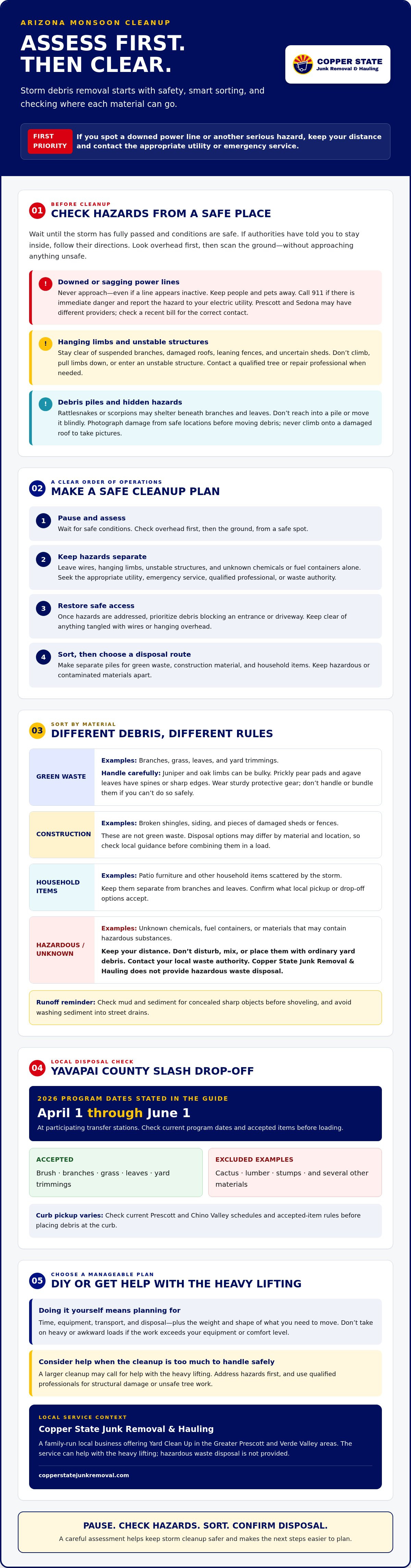
It’s understandable to feel worn out by heavy lifting and unsure what your city or county will accept. This guide explains how to assess damage safely, sort debris by type, and find the right disposal route before moving anything. If you spot a downed power line or another serious hazard, keep your distance and contact the appropriate utility or emergency service.
You’ll also learn what to check before using municipal bulk pickup or local drop-off programs, and when a larger cleanup may call for help. We’ll cover practical steps for getting your property back in order, including how Copper State Junk Removal & Hauling’s Yard Clean Up service can help with the heavy lifting in the Greater Prescott and Verde Valley areas.
Key Takeaways
- Sort storm debris into clear categories before hauling it, then check which disposal options accept each material.
- Handle cactus and other prickly desert plants with extra care. Don’t take on heavy or awkward loads if the work exceeds your equipment or comfort level.
- Check current Prescott and Chino Valley pickup schedules and accepted-item rules before placing debris at the curb.
- Compare the time, equipment, transport, and disposal involved in DIY cleanup with getting help for the heavy lifting.
- Copper State Junk Removal & Hauling is a family-run local business offering Yard Clean Up in the Greater Prescott and Verde Valley areas.
Safety First: Assessing Storm Damage on Your Arizona Property
Arizona monsoons can leave more than branches scattered across a yard. High winds may snap limbs in ponderosa pines, loosen roof materials, and push desert plants across paths and driveways. Wait until the storm has fully passed and conditions are safe before going outside. If authorities have warned you to stay inside, follow their directions.
Before beginning storm debris removal, take a slow look from a safe spot. Check overhead first, then scan the ground. A careful assessment can help you avoid turning property damage into a personal injury.
Identify Immediate Hazards
Look for broken or hanging limbs, sometimes called “widow-makers,” caught high in trees. Wind can leave them suspended, ready to fall without warning. Don’t stand beneath them, climb to reach them, or try to pull them down. Keep clear and contact a qualified tree professional.
Never approach a downed or sagging power line, even if it appears inactive. Keep people and pets away, then call 911 if there’s immediate danger and report the hazard to your electric utility. Prescott and Sedona can have different utility providers, so check a recent bill for the correct contact. Treat debris piles with caution, too. Rattlesnakes or scorpions may shelter beneath branches or leaves, so don’t reach into a pile or move it blindly.
Separate Unsafe Materials from Cleanup Debris
Some damaged items, such as unknown chemicals, fuel containers, or materials that may contain hazardous substances, need specialized handling. Don’t place them with ordinary yard debris or assume a hauling provider can take them. Keep your distance, avoid disturbing or mixing them, and contact your local waste authority for guidance. Copper State Junk Removal & Hauling does not provide hazardous waste disposal.
Restoration involves more than clearing what’s visible. This overview of the disaster restoration process offers broader context on assessing damage and determining what may be salvaged. For insurance documentation, photograph damage from safe locations before moving debris. Capture wide views and closer details, and make a simple inventory for your insurer. Don’t climb onto a damaged roof to get a better picture.
Check Structures and Prioritize Access
From the ground, look for leaning fence sections, shifted posts, damaged sheds, and fallen branches on the roof. Don’t enter an outbuilding or walk beneath a damaged roof if its stability is uncertain. Note what you can see and share it with your insurer or a qualified repair professional.
Next, identify debris blocking an entrance or driveway. Keep clear of anything tangled with wires or hanging overhead. Once hazards are addressed, plan cleanup in a sensible order: restore safe access first, then tackle less urgent yard debris. If damage appears structural, leave the repair and removal to qualified professionals.
Understanding Different Types of Storm Debris
After an Arizona monsoon, a yard can hold several kinds of debris at once. Sorting them before cleanup helps you choose safer handling methods and check which disposal options may accept each material. Make separate piles for green waste, construction material, and household items. Keep anything hazardous or contaminated apart, and don’t assume it belongs in regular yard waste.
The Challenge of Arizona Green Waste
Monsoon gusts can scatter leaves and small branches, but the tougher problem is often heavy limbs and uprooted shrubs. Juniper and oak branches can be bulky and awkward to move. Prickly pear pads and agave leaves need special care because their spines and sharp edges can injure anyone handling them. Wear sturdy protective gear, and don’t grab or bundle plants by hand if you can’t do so safely.
Branches and dry vegetation left in a pile can add to fuel around a property as the weather dries. Once hazards have been assessed, plan to clear manageable green waste and check local rules before hauling it away. Yavapai County’s 2026 Free Slash Drop-Off Program ran from April 1 through June 1 at participating transfer stations. It accepted brush, branches, grass, leaves, and yard trimmings, but excluded cactus, lumber, stumps, and several other materials. Check current program dates and accepted items before loading.
Separate Non-Organic Debris
Storms can scatter patio furniture, household items, and pieces of damaged sheds or fences. Sort these apart from branches and leaves. Broken shingles and siding are construction debris, not green waste, and disposal options may differ by material and location. Check local guidance before combining them in one load.
Monsoon runoff can also leave mud and sediment across paths, patios, and low spots. Look for concealed sharp objects before shoveling, and avoid washing sediment into street drains. If water has entered the home, or debris is mixed with unknown chemicals or other hazardous materials, don’t handle it as ordinary cleanup. The CDC’s storm cleanup safety guidance covers protective steps and dangerous materials. Copper State Junk Removal & Hauling doesn’t offer hazardous waste disposal, so contact local authorities for direction on those items.
A damaged hot tub can be especially difficult to move, while waterlogged furniture and shed fragments may be heavier than they look. Separate items that need repair from those you’re ready to clear, and don’t lift bulky debris without suitable help. For yard debris and eligible items, a local provider can take on the physical work. Copper State Junk Removal & Hauling offers Yard Clean Up in the Greater Prescott and Verde Valley areas, helping you move from sorting to a clearer property.
DIY Cleanup vs. Professional Storm Debris Removal
Not every storm mess needs a hauling crew. A few scattered leaves and small branches may be manageable on your own. A yard full of heavy limbs, awkward debris, or bulky items is a different job. Before choosing, consider the load, your physical limits, the equipment you have, and how you’ll get the debris to an approved disposal site.
When DIY Makes Sense
DIY cleanup can work well for light, low-risk tasks. Raking leaves, gathering small branches, and placing accepted items in municipal bins may be reasonable if you can do the work without overreaching or straining. Check local pickup rules first, since curbside programs may limit what they accept and how debris must be prepared.
Keep the job within your limits. Don’t handle branches tangled with power lines, unstable structures, heavy limbs, or spiny desert plants without suitable training and equipment. Stop if you uncover wildlife, sharp fragments, or materials that may be hazardous.
Look Beyond the First Trip
DIY costs can add up beyond the time spent raking. Depending on the job, you may need to arrange a truck rental, cover fuel, pay disposal fees, and make more than one trip. Heavy or awkward loads also raise the risk of strains, cuts, or other injuries. Compare the full effort and expense, not just the idea that doing it yourself is free.
Professional hauling may make sense when debris is too bulky to fit in household bins, access to disposal is difficult, or repeated trips would take time away from other priorities. A hauling provider may be able to take eligible heavy items and yard debris, but confirm what materials they accept. Hazardous waste requires a separate disposal route. Copper State Junk Removal & Hauling does not provide hazardous waste disposal.
Choose the Right Help for the Job
For a small, accessible cleanup, a rake and a few careful trips may be enough. For a larger pile, getting help can reduce the lifting and repeated loading that turn a simple cleanup into a multiday chore. The time required depends on the volume, access, and type of debris, so don’t assume every job can be cleared in a set number of hours.
Copper State Junk Removal & Hauling is a family-run local business serving the Greater Prescott and Verde Valley areas. Its Yard Clean Up service can help with eligible storm-related yard debris and heavy lifting. Discuss the material and scope before arranging service, then choose the option that lets you avoid taking on more work than you can safely manage.
Navigating Local Disposal and Municipal Rules in Yavapai County
Storm debris removal isn’t one-size-fits-all. City bulk pickup, county transfer stations, and private hauling each have different limits. Before dragging a pile to the curb or loading a truck, confirm who serves your address, what materials are accepted, and how debris must be prepared. Prescott Valley and Chino Valley schedules and rules can change, so check current municipal information rather than relying on an old calendar.
Check Curbside Pickup Limits First
Municipal pickup is convenient for eligible items, but it may not cover every storm cleanup. Programs can set rules for item type, pile size, placement, and collection timing. A curbside pile may be unsuitable if it blocks a sidewalk, driveway, or street access. After a major storm, collection timing may also differ from the usual schedule. Confirm details with your municipality before setting debris out.
Yavapai County’s 2026 Free Slash Drop-Off Program ran from April 1 through June 1 at participating transfer stations. It accepted brush, branches, grass, leaves, and yard trimmings, but not lumber, stumps, roots, cactus, metal, or garbage. The program is seasonal, so check the county’s current information for future dates and accepted materials. County transfer stations include locations in Black Canyon City, Camp Verde, Congress, Mayer, Paulden, Seligman, and Skull Valley. Verify each site’s requirements before self-hauling.
Choose the Right Disposal Route
For self-hauling, separate green waste from construction debris, household items, and anything that may be hazardous. Contact the receiving facility to confirm what it accepts, along with any preparation, load, or fee requirements. Don’t assume a transfer station takes every material. Keep hazardous items out of ordinary loads and ask the appropriate local authority how to handle them.
Open burning isn’t a shortcut to a clear yard. Rules and restrictions can depend on location and conditions. Before burning any debris, contact your local fire district or county to find out what is allowed. Never burn unknown materials or debris that could release harmful smoke.
When Private Hauling May Help
If curbside service won’t take your pile, or you can’t safely move bulky debris yourself, private hauling may be another option. It can help avoid leaving a large pile at the curb while you wait for a collection window. Ask the provider what materials they handle and confirm scheduling directly. Copper State Junk Removal & Hauling offers Yard Clean Up and Renovation Cleanup in the Greater Prescott and Verde Valley areas, but does not provide hazardous waste disposal.
Need help clearing eligible yard debris or renovation material? Arrange local cleanup and hauling with Copper State Junk Removal & Hauling, and confirm accepted items before service.
Efficient Property Restoration with Copper State Junk Removal
A storm-damaged yard can feel like a project with no clear starting point. Copper State Junk Removal & Hauling is a family-run business serving local communities across Chino Valley, Prescott, Prescott Valley, Paulden, Dewey, Mayer, Jerome, Clarkdale, Cottonwood, Camp Verde, the Verde Valley, and Sedona. The company provides residential and commercial junk removal and hauling, including specialized clean-outs. Its services can help local residents clear eligible items and regain usable space without taking on every heavy lift themselves.
Local Help for the Cleanup Ahead
Every cleanup has its own mix of debris. You may be dealing with scattered branches and yard waste, or bulky items like a damaged mattress or patio hot tub. Copper State Junk Removal & Hauling offers Yard Clean Up, Mattress Removal, Hot Tub Removal, and Renovation Cleanup, among other listed services. Share what was damaged and what needs to go so the company can confirm whether your items fit its services.
Storm debris removal can involve materials that require different disposal routes. Copper State Junk Removal & Hauling doesn’t offer hazardous waste disposal, so keep unknown or hazardous items separate and contact the appropriate local authority for handling guidance. For eligible items, a local hauling provider can take on the physical work and help make the transition from a cluttered property to cleared space more manageable.
Know What to Ask Before Scheduling
To discuss your cleanup, be ready to describe the debris, approximate amount, and where it’s located on the property. Mention access issues, such as a narrow gate or items behind a building, and flag anything that may be hazardous. Photos may help explain the job, but ask the company what information it needs to assess your request.
Before arranging service, confirm which items are accepted, what the quoted work includes, how pricing is determined, and what scheduling options are available. Clear answers help you compare private hauling with municipal pickup and avoid surprises. Don’t assume the company can take every material or provide a specific arrival time unless those details are confirmed directly.
The goal is a simpler cleanup, not more uncertainty. Discuss your needs with a local team, confirm the scope, and decide whether its services fit your debris and timeline. For help with eligible yard debris or bulky items in the Greater Prescott and Verde Valley areas, Let Copper State Junk Removal & Hauling handle the heavy lifting.
Take the Next Step Toward a Clearer Property
A safer cleanup starts with patience: stay clear of downed lines and unstable structures, sort debris by type, and check local disposal rules before hauling anything away. Small, manageable jobs may suit DIY cleanup, but heavy or bulky debris can call for extra help.
Storm debris removal doesn’t have to mean handling every load yourself. Copper State Junk Removal & Hauling is a family-run local business serving the Greater Prescott and Verde Valley areas, with a focus on fast, affordable hauling. For eligible yard debris, ask about its Yard Clean Up service and confirm which materials can be taken.
Ready to take the heavy lifting off your list? Contact Copper State Junk Removal & Hauling about Yard Clean Up and discuss what your property needs. With a clear plan and the right help, you can move from storm damage toward a safer, more usable yard.
Frequently Asked Questions
What is considered storm debris?
Storm debris includes material blown, broken, uprooted, or displaced by high winds and heavy rain. In Arizona, that can mean branches, leaves, uprooted shrubs, prickly cactus, and agave, along with damaged shingles, fencing, patio furniture, or household items. Mud and sediment may also remain after runoff. Sort debris by type, and keep anything hazardous or unknown separate for appropriate handling.
Does the city of Prescott pick up fallen trees after a storm?
Prescott’s pickup rules and schedules determine whether fallen tree debris is collected, so check directly with the city before placing a pile at the curb. Ask about size, preparation, placement, and whether collection is affected after a major storm. Don’t assume curbside service will take a whole tree or heavy limbs. Residents in Prescott Valley and Chino Valley should check their own municipality’s current rules.
How much does storm debris removal usually cost?
The cost depends on the amount and type of debris, how difficult it is to access, and the hauling and disposal needed. A small load of loose branches differs from bulky or heavy storm damage. Copper State Junk Removal & Hauling can discuss the job and its pricing directly. Describe the materials, approximate volume, and access conditions so the company can determine what information is needed for an estimate.
Can you remove a hot tub that was damaged in a storm?
Copper State Junk Removal & Hauling offers Hot Tub Removal, so you can ask whether your storm-damaged unit is suitable for removal. Share its location, condition, and any access challenges, such as narrow gates or steps. Don’t try to move a damaged or waterlogged hot tub yourself if it’s unstable or too heavy. Keep clear of nearby downed lines or structural hazards until they’ve been addressed.
Do you handle hazardous waste like chemicals or batteries found in debris?
No. Copper State Junk Removal & Hauling does not offer hazardous waste disposal. Keep chemicals, batteries, fuel, and unidentified substances out of ordinary debris piles, and don’t pour them into drains or mix them together. Contact your local waste authority for instructions on safe handling and disposal. If a container is leaking or there’s an immediate danger, keep people and pets away and contact the appropriate emergency service.
How soon can you come out after a monsoon event?
Scheduling depends on availability and the details of your cleanup, so contact Copper State Junk Removal & Hauling directly to discuss timing. The company doesn’t provide 24/7 emergency service or Sunday service, and a specific arrival time can’t be assumed. Before arranging a visit, explain the debris type, approximate amount, and location. Stay away from downed power lines, unstable structures, and other hazards while waiting.
Do I need to be home when the debris is being hauled away?
Ask Copper State Junk Removal & Hauling whether you need to be present for your particular job. The answer may depend on access, where debris is located, and how the items to be removed are identified. Before scheduling, agree on the work area and any access arrangements, and keep pets and people clear of the hauling path. Don’t leave hazardous or uncertain materials mixed into the pile.
What happens to the debris after you pick it up?
Disposal depends on the material and the receiving facility’s rules. Ask the hauling provider how your items will be handled and whether any materials can be recycled or need a separate disposal route. Yard waste, construction debris, furniture, and hazardous items may not share the same destination. Copper State Junk Removal & Hauling serves communities including Prescott, Chino Valley, Sedona, Cottonwood, Camp Verde, and Mayer. Confirm accepted materials before arranging hauling.


